

How to Start an Online Pharmacy in the UK: 2026 Complete Guide
Complete step-by-step guide to starting an online pharmacy in the UK — covering GPhC registration, premises requirements, prescriber qualifications, clinical governance, platform selection, and go-live checklist.
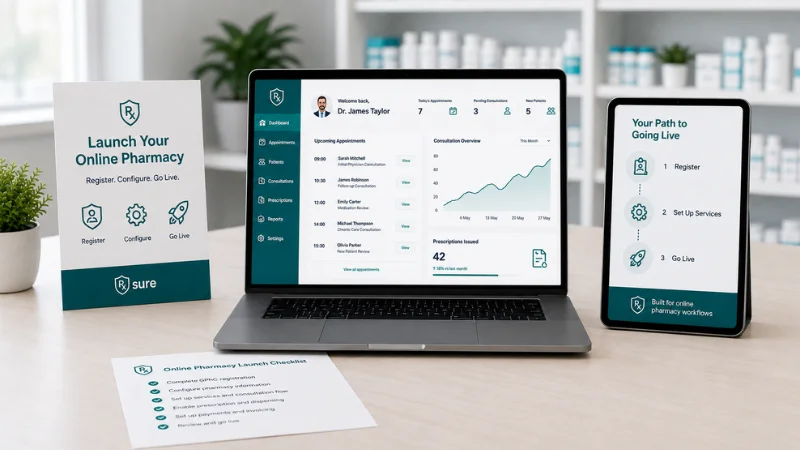
TL;DR: Starting an online pharmacy in the UK requires GPhC registration, a responsible pharmacist, compliant premises, and a digital platform for consultations and prescribing. This guide walks through every regulatory and operational step, from initial application to going live with patients.
The online pharmacy sector in the UK continues to grow. The GPhC (General Pharmaceutical Council) registered 394 internet pharmacies as of March 2024, up from 371 in 2022, a steady increase reflecting both patient demand and regulatory confidence in digital models. If you are a pharmacist or pharmacy owner considering launching an online service, understanding the regulatory framework is essential before investing in technology or premises.
This guide covers the complete process: from GPhC requirements through to choosing a prescribing platform and accepting your first patients.
Step 1: Understand the Regulatory Landscape
Every pharmacy operating online in the UK must be registered with the GPhC under the Pharmacy Order 2010. There is no separate “online pharmacy licence”, you register premises and declare that services will be provided via the internet. The GPhC then applies its standards for registered pharmacies, with additional expectations for distance selling.
Key regulatory documents you must read before proceeding:
- Standards for Registered Pharmacies (GPhC, 2024), the five principles that govern all pharmacy practice
- Guidance for Registered Pharmacies Providing Pharmacy Services at a Distance, specific requirements for online and telephone services
- In the Absence of a Responsible Pharmacist guidance, rules for when a pharmacist must be present
- Medicines, Ethics and Practice (MEP) guide, the Royal Pharmaceutical Society’s annual practice reference
The key principle: patients receiving pharmacy services online must receive the same standard of care as those visiting a physical pharmacy. Distance does not reduce your obligations, it increases them in certain areas, particularly identity verification and clinical appropriateness checks.
Step 2: GPhC Premises Registration
You need registered premises even for a purely online pharmacy. The GPhC requires a physical address from which pharmacy services are directed. This does not need to be a high-street location, it can be an office or workspace, but it must meet certain standards:
- Adequate space for the safe storage of medicines (if dispensing)
- Secure, private area for the responsible pharmacist to practise
- Appropriate IT infrastructure and security measures
- Compliance with health and safety regulations
The registration fee is £261 for new premises (2024/25 GPhC fee schedule). Annual retention is £261. Allow 30-60 working days for the application to be processed, though complex applications may take longer.
Step 3: Appoint a Responsible Pharmacist and Superintendent
Under the Medicines Act 1968 and the Responsible Pharmacist Regulations 2008:
- A Responsible Pharmacist (RP) must be in charge of the pharmacy at all times it is open. For online pharmacies, “open” means any time orders are being processed or clinical services are being provided.
- If you are a body corporate (limited company), you must appoint a Superintendent Pharmacist who has overall responsibility for the safe and effective running of the pharmacy business.
The RP and Superintendent can be the same person in a single-site operation. Both must be registered with the GPhC and hold current practising certificates without conditions that would prevent them from fulfilling these roles.
Step 4: Choose Your Service Model
Online pharmacies in the UK generally operate under one or more of these models:
| Model | Description | Key Requirement |
|---|---|---|
| Dispensing only | Patients send NHS or private prescriptions; you dispense and deliver | Dispensary, delivery logistics |
| Prescribing + dispensing | Independent prescriber consultations followed by in-house dispensing | IP-qualified pharmacist, clinical governance framework |
| Prescribing only | Consultations and prescriptions issued; patient collects elsewhere or uses delivery pharmacy | Digital prescribing platform, IP qualification |
| Hybrid | Physical pharmacy with online consultation arm | Integrated systems, dual workflow management |
The prescribing-only model has the lowest capital requirement, no dispensary fit-out, no stock holding, no delivery infrastructure. You focus purely on clinical consultations and issuing private prescriptions. This is where platforms like RxSure provide the most value, handling patient booking, clinical assessment workflows, and prescription generation.
Step 5: Obtain Independent Prescriber Qualification (If Prescribing)
If your model includes prescribing, you or your prescribers need the Independent Prescriber (IP) annotation on the GPhC register. This requires:
- A GPhC-accredited independent prescribing programme (typically 6-12 months part-time)
- At least two years of post-registration experience (GPhC requirement)
- A designated medical practitioner (DMP) to supervise your learning in practice
- Successful completion of the programme, including a period of supervised prescribing
As of 2024, the GPhC register shows over 16,000 pharmacist independent prescribers in Great Britain, a number growing by approximately 2,000 per year as more universities expand programme capacity. The profession is firmly moving toward prescribing as a core competency.
Step 6: Set Up Clinical Governance
The GPhC expects every pharmacy to have a clinical governance framework proportionate to the services offered. For online prescribing services, this must include:
- Standard Operating Procedures (SOPs), covering every aspect of the patient journey from initial enquiry to prescription issuance and follow-up
- Clinical audit programme, regular review of prescribing decisions against guidelines (NICE, BNF)
- Incident reporting and learning, a system for recording near misses, patient safety incidents, and complaints
- Patient feedback mechanism, required under GPhC Standard 2
- Safeguarding policy, particularly important for services treating vulnerable adults or conditions with safeguarding implications
- Data protection impact assessment, required under UK GDPR for health data processing
Don’t underestimate this step. GPhC inspectors consistently cite inadequate governance frameworks as a reason for enforcement action. Build your governance before you build your website.
Step 7: Choose Your Digital Platform
Your technology platform is the operational backbone of an online pharmacy. At minimum, you need:
- Patient registration and identity verification, GPhC requires you to verify patient identity for distance-selling services
- Clinical consultation workflow, structured questionnaires, video or asynchronous consultation capability
- Prescribing and prescription generation, compliant private prescription format
- Clinical records, secure, searchable, auditable patient records
- Appointment booking, patient self-service scheduling
Building custom software is expensive and slow. Most new online pharmacies choose an established platform. RxSure offers flat-rate pricing at £199/month with no per-prescription fees, making costs predictable from day one. The platform handles patient booking, pre-screening questionnaires, clinical assessment templates, and prescription generation, letting you focus on clinical care rather than IT development.
Step 8: Website and Patient-Facing Compliance
Your pharmacy website must display specific information required by the GPhC:
- GPhC registration number and the registered pharmacy name and address
- The GPhC internet pharmacy logo (EU common logo), clickable, linking to the GPhC register
- Name of the superintendent pharmacist and responsible pharmacist
- Contact details including a telephone number staffed during opening hours
- Complaints procedure
- Privacy policy compliant with UK GDPR
- Cookie consent mechanism
The GPhC conducts intelligence-led inspections of online pharmacies. Non-compliant websites can trigger an inspection visit or a request for information under the Pharmacy Order.
Step 9: Go Live Checklist
Before accepting your first patient, confirm:
- GPhC premises registration confirmed and certificate received
- Responsible Pharmacist record published (RP notice requirements met)
- Professional indemnity insurance in place (adequate for online prescribing services)
- ICO registration completed (data controller registration)
- SOPs written, reviewed, and signed off
- Platform tested with dummy patients, full workflow from booking to prescription
- Safeguarding policy and escalation pathways documented
- GPhC internet pharmacy logo live on website with correct hyperlink
- Patient feedback mechanism active
- Business continuity plan in place (what happens if your platform goes down?)
Common Mistakes to Avoid
Based on GPhC inspection findings and fitness-to-practise cases:
- Prescribing outside scope of competence, define your formulary before launch. Don’t be tempted by demand for services you aren’t trained to provide.
- Inadequate patient identity verification, “tick box” questionnaires without genuine verification expose you to fraud and regulatory action.
- No GP notification process, the GPhC expects prescribers to notify the patient’s GP of any prescriptions issued (with patient consent). Build this into your workflow.
- Poor record keeping, if it’s not documented, it didn’t happen. Your platform must capture the complete clinical rationale for every prescribing decision.
- Ignoring clinical red flags, your questionnaires and consultation process must identify patients who need referral rather than prescribing.
Costs: What to Budget
| Item | Typical Cost | Frequency |
|---|---|---|
| GPhC premises registration | £261 | One-off + £261/year retention |
| Professional indemnity insurance | £500–£2,000 | Annual |
| ICO registration | £40–£2,900 | Annual (tier-dependent) |
| Prescribing platform | £199/month | Monthly (RxSure flat rate) |
| Website development | £2,000–£10,000 | One-off |
| IP course (if not already qualified) | £1,500–£4,000 | One-off |
Total startup costs for a prescribing-only online pharmacy typically range from £5,000 to £15,000, significantly less than a traditional bricks-and-mortar pharmacy. The lower barrier to entry is one reason the model is attracting entrepreneurial prescribers.
Frequently Asked Questions
Do I need a physical premises for an online-only pharmacy?
Yes. The GPhC requires a registered premises address from which pharmacy services are directed. This can be an office space rather than a retail unit, but it must meet GPhC standards for the services you provide. If you are only prescribing (not dispensing), the premises requirements are less extensive than for a dispensing pharmacy.
How long does GPhC registration take?
Allow 30-60 working days from submission of a complete application. Incomplete applications or those requiring additional information will take longer. The GPhC may conduct a pre-registration inspection of your premises before granting registration.
Can I prescribe for any condition?
No. You may only prescribe within your defined scope of competence. The GPhC Standards for Pharmacy Professionals require you to “recognise and work within the limits of your knowledge and skills.” Your formulary and service specification must clearly define what conditions you treat and which require referral.
What insurance do I need?
Professional indemnity insurance is a legal requirement for all practising pharmacists (Health Care and Associated Professions (Indemnity Arrangements) Order 2014). For prescribing services, ensure your policy specifically covers independent prescriber activity and online consultations. Providers include Hiscox, Howden, and specialist pharmacy insurers.
Can I use RxSure from day one?
Yes. RxSure offers a free trial that lets you explore the platform before committing. Once you have your GPhC registration and governance framework in place, you can go live with patients immediately, the platform handles consultation booking, clinical workflows, and prescription generation. Setup typically takes under an hour.
References
- General Pharmaceutical Council. Standards for Registered Pharmacies. 2024. pharmacyregulation.org
- General Pharmaceutical Council. Guidance for Registered Pharmacies Providing Pharmacy Services at a Distance. 2022. pharmacyregulation.org
- General Pharmaceutical Council. Registration fees 2024-25. pharmacyregulation.org
- General Pharmaceutical Council. GPhC Register data, Internet pharmacies. March 2024.
- Responsible Pharmacist Regulations 2008. legislation.gov.uk
Ready to Launch Your Online Pharmacy?
RxSure provides the complete prescribing platform, patient booking, clinical workflows, and prescription generation. Flat £199/month, no per-prescription fees.