

Pharmacy Compliance Certificate Management: Complete Guide 2026
Learn how to manage pharmacy compliance certificates effectively. Avoid expired documents, pass GPhC inspections, and protect your practice with our comprehensive guide.
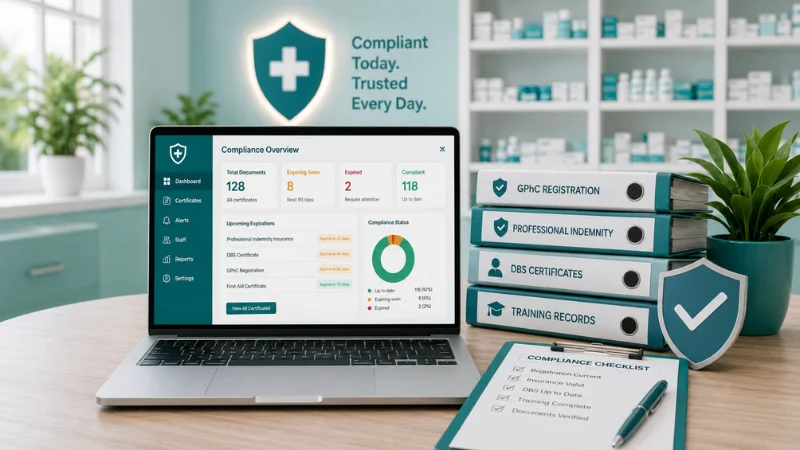
Every pharmacy in the United Kingdom operates under a complex web of regulatory requirements. From GPhC registration certificates to professional indemnity insurance, DBS checks to training records, the paperwork burden is immense. Yet despite the critical importance of maintaining valid documentation, a shocking 47% of pharmacies have at least one expired compliance document at any given time.
This is not a reflection of poor management or lack of care. It is a symptom of an outdated system that relies on manual tracking, paper filing, and human memory to manage hundreds of documents with different expiry dates.
The consequences of compliance failures extend far beyond administrative inconvenience. Expired professional indemnity insurance can invalidate your ability to practice legally. Lapsed DBS certificates raise safeguarding concerns. Missing training records suggest inadequate professional development. Each of these issues can trigger regulatory action, damage your professional reputation, and ultimately harm patient safety.
Understanding Pharmacy Certificate Requirements
Professional Registration Certificates
Every pharmacist and pharmacy technician must maintain valid registration with the General Pharmaceutical Council. The GPhC registration certificate confirms that the professional has met all requirements for practice, including character checks, health declarations, and continuing professional development requirements.
Registration renewal occurs annually, typically in April for pharmacists and October for pharmacy technicians. However, the exact renewal date depends on when the professional first registered. This variation in renewal dates across a team creates a complex tracking challenge for pharmacy managers.
Key requirements:
- Annual renewal with GPhC
- CPD record maintenance
- Revalidation submission for pharmacists
- Fitness to practise declarations
Professional Indemnity Insurance
GPhC Standard 1.7 requires all pharmacy professionals to have appropriate indemnity arrangements in place. This insurance protects both the professional and patients in case of negligent acts, errors, or omissions during professional practice.
For employed pharmacists, employer liability typically covers professional indemnity. However, pharmacists engaged in any private work, locum arrangements, or additional services must ensure their personal cover extends to all activities. Many pharmacists are unaware that their employer insurance may not cover activities outside their contracted role.
Minimum recommended cover:
- 2 million pounds for standard pharmacy practice
- 5 million pounds or more for clinical services, prescribing, or NHS contracts
- Specific cover for any specialist services offered
Disclosure and Barring Service DBS Certificates
All pharmacy staff with access to patients, medicines, or confidential information require appropriate DBS checks. The level of check required depends on the role:
- Basic DBS: Entry-level positions with limited access
- Standard DBS: Roles with regular patient contact
- Enhanced DBS: Positions involving vulnerable adults or children
- Enhanced with Barred List: Regulated activity with vulnerable groups
DBS certificates do not have a formal expiry date, but best practice and many employers require renewal every three years. The DBS Update Service allows continuous monitoring but requires annual subscription and employee consent.
Training and Competency Records
Pharmacy teams require ongoing training across multiple domains:
- Mandatory training: Safeguarding, health and safety, infection control, GDPR
- Role-specific training: Dispensing accuracy, medicines counter assistant qualification
- Service-specific training: Vaccination competency, independent prescriber training, consultation skills
- CPD: Minimum 9 planned CPD entries annually for GPhC registrants
Each training certificate has its own validity period. Safeguarding training typically requires annual renewal. First aid certificates last three years. Vaccination competency may require annual updates depending on the service specification.
The True Cost of Expired Compliance Documents
Regulatory Consequences
GPhC inspectors now focus heavily on evidence of compliance during pharmacy inspections. The new focused inspection model, introduced in January 2025, specifically examines 18 core standards with compliance documentation featuring prominently.
An inspection finding of expired or missing documentation does not just result in action points. It calls into question the pharmacy overall governance and risk management. Multiple compliance failures can shift an overall rating from Good to Requires Improvement regardless of clinical care quality.
Financial Impact
The financial consequences extend beyond potential regulatory fines:
- Insurance invalidation: Operating without valid professional indemnity can void related claims
- Contract breaches: NHS and private contracts typically require proof of current insurance and training
- Locum costs: Staff unable to work due to expired registrations require emergency cover
- Remediation expenses: Urgent training, accelerated processing fees, compliance consultant costs
Reputational Damage
In an era of increasing pharmacy competition and public accountability, compliance failures can devastate professional reputation. CQC and GPhC inspection reports are publicly available. Poor ratings affect patient confidence, NHS contract opportunities, and staff recruitment.
Building an Effective Certificate Management System
Centralised Document Repository
The foundation of effective compliance management is a single source of truth for all documentation. Whether digital or physical, every certificate, training record, and policy document should have a designated location known to all relevant staff.
Digital systems offer significant advantages:
- Searchable records
- Automatic backup
- Access from any location
- Version control
- Audit trails
Proactive Expiry Tracking
Reactive compliance management discovering expired documents during audits or inspections is inherently risky. Effective systems provide graduated warnings:
- 90 days: Initial awareness alert
- 60 days: Action required reminder
- 30 days: Urgent attention warning
- 14 days: Critical deadline approaching
- Expired: Immediate escalation and potential service restriction
Accountability and Escalation
Clear ownership of compliance responsibilities ensures nothing falls through the cracks. Best practice includes:
- Named compliance lead with dedicated time allocation
- Individual responsibility for personal certificates
- Manager oversight and verification
- Director-level escalation for persistent issues
- External audit arrangements
Technology Solutions for Modern Pharmacy Compliance
Manual compliance tracking using spreadsheets, calendars, and paper systems is no longer fit for purpose. The volume of documents, complexity of requirements, and consequences of failure demand purpose-built solutions.
Modern pharmacy compliance platforms offer:
- Automated expiry tracking: System monitors all document dates and generates alerts
- Staff self-service: Team members upload their own certificates directly
- Verification workflows: Managers approve documents with audit trail
- Real-time dashboards: Instant visibility of compliance status across team
- Inspector-ready reports: Generate evidence packs at the click of a button
- Multi-site management: Centralised oversight of multiple locations
Taking Action: Your Compliance Improvement Plan
Improving pharmacy compliance does not require new change. It requires systematic attention to documentation management.
Immediate actions:
- Audit all current certificates and identify any already expired
- Create a master list of all documents with expiry dates
- Assign ownership for each document category
- Establish a regular review schedule minimum monthly
Short-term improvements:
- Implement 90-day advance warning system
- Create template checklists for new starter documentation
- Develop process for leaver documentation archive
- Schedule quarterly compliance review meetings
Long-term transformation:
- Evaluate digital compliance management platforms
- Integrate compliance tracking with HR and training systems
- Establish continuous improvement based on near-miss analysis
- Develop compliance as a positive team culture rather than burden
Protect Your Pharmacy, Your Team, and Your Patients
Compliance certificate management may seem administrative, but its impact is fundamentally about patient safety and professional integrity. Every expired certificate represents a gap in the governance framework that protects patients and professionals alike.
The pharmacies that thrive under increasing regulatory scrutiny are those that view compliance not as a burden but as an essential component of quality care. They invest in systems, dedicate time, and create cultures where compliance is everyone responsibility.
Ready to transform your pharmacy compliance management?
RxSure provides comprehensive compliance tracking designed specifically for UK pharmacies. Our platform automatically monitors certificate expiry dates, sends graduated alerts, enables staff self-service uploads, and generates inspection-preparation evidence packs.
Start your free trial today and discover how modern compliance management can protect your practice while reducing administrative burden.