

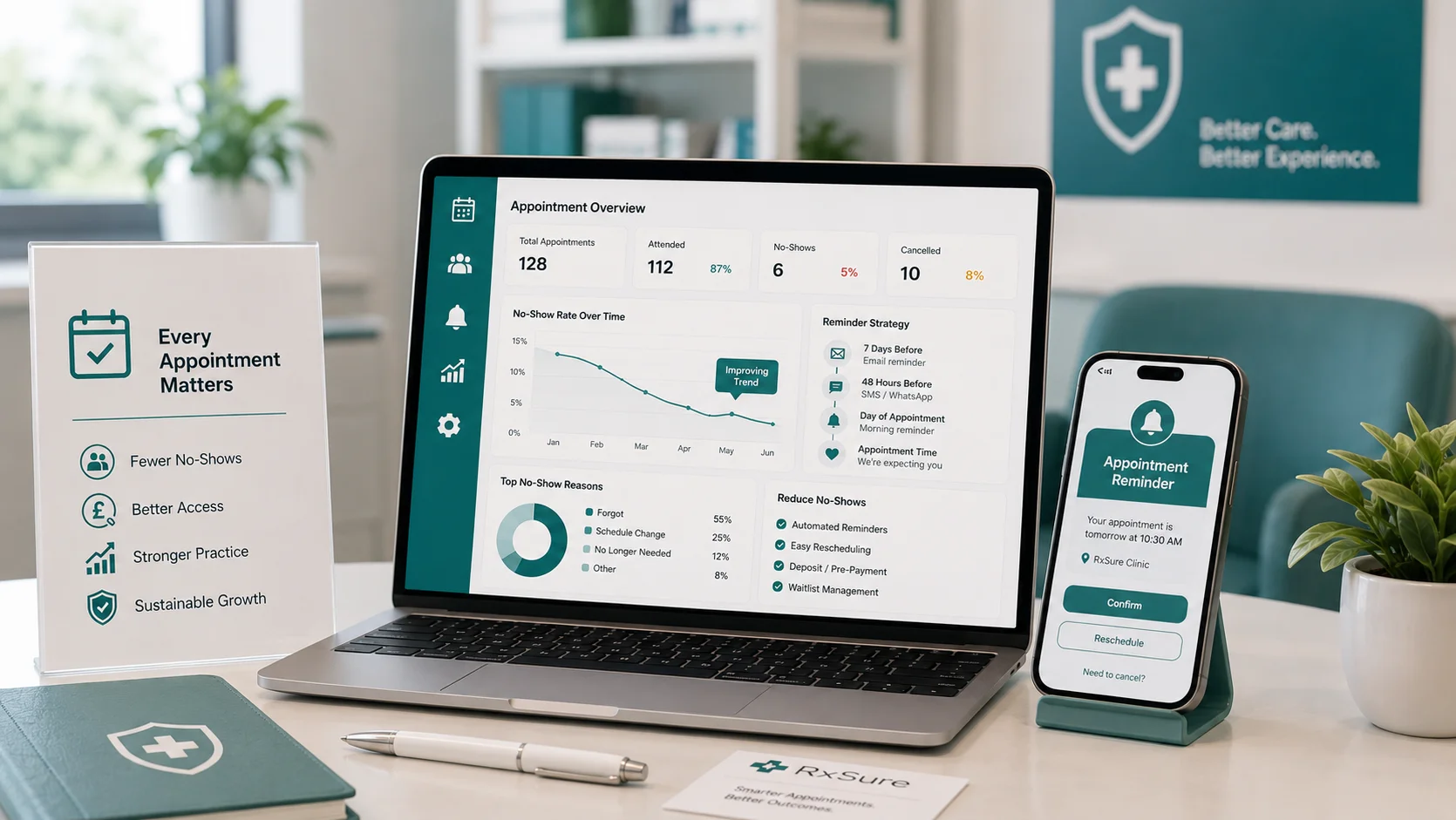
TL;DR: No-shows cost private prescribers time and money. Learn strategies to reduce missed appointments using automated reminders, deposits, and smart booking systems.
Every empty appointment slot costs your private prescribing practice money, time, and opportunity. When a patient fails to attend a scheduled consultation, the impact extends far beyond a single missed booking. That slot could have served another patient. Your preparation time was wasted. Your revenue forecast takes a hit. For independent prescribers building a sustainable private practice, reducing no-shows is not optional, it is essential for business survival and growth.
Research across private healthcare services in the United Kingdom suggests that no-show rates typically range from 10% to 20% for appointment-based services. For a prescriber conducting twenty consultations per week, that could mean two to four missed appointments, potentially hundreds of pounds in lost revenue every single week. Over a year, no-shows can cost a busy prescribing practice thousands of pounds, not to mention the downstream effects on patient care and operational efficiency.
The good news is that no-shows are not inevitable. With the right combination of communication strategies, booking policies, and technology solutions, private prescribers can dramatically reduce missed appointments and protect their practice revenue.
The True Cost of No-Shows for Private Prescribers
Electronic prescribing software has become essential for UK healthcare professionals who issue private prescriptions, replacing handwritten paper forms with secure digital workflows that reduce prescription errors, speed up consultations, and create complete audit trails. In the private prescribing sector, where prescriptions fall outside the NHS Electronic Prescription Service, practitioners need dedicated e-prescribing platforms that handle the entire workflow from patient assessment through medication selection, dosage calculation, prescription generation, and dispensing verification. The key advantages of e-prescribing over paper-based systems include elimination of illegibility errors which account for approximately ten per cent of prescription-related incidents, automatic drug interaction and contraindication checking against the patient’s medication history, structured prescription formats that comply with GPhC and CQC requirements, digital signatures with tamper-proof verification, and searchable records that simplify clinical audits and regulatory inspections. Modern e-prescribing platforms such as RxSure integrate prescription generation into a broader workflow that also covers patient booking, clinical consultations, and payment processing.
Direct Revenue Loss
The most obvious cost of a no-show is the consultation fee you do not collect. If your average consultation costs sixty to eighty pounds, and you experience three no-shows per week, that is between nine thousand and twelve thousand pounds in lost annual revenue. For a practice in its early stages, this can be the difference between profitability and struggle.
Wasted Preparation Time
Private prescribing consultations require preparation. You may have reviewed the patient pre-screening questionnaire, checked their medical history, researched relevant clinical guidelines, and mentally prepared for the consultation. When the patient does not appear, all of that preparation time is lost. Unlike a retail pharmacy where you can immediately redirect your attention, a booked appointment creates a dedicated window that cannot easily be repurposed.
Impact on Other Patients
Perhaps the most frustrating aspect of no-shows is that other patients who needed that slot were turned away or asked to wait. In a service with limited appointment availability, every missed slot represents a patient who could have been seen but was not. This creates dissatisfaction amongst your wider patient base and can slow practice growth.
Operational Disruption
No-shows disrupt the rhythm of your clinic. Staff may have been scheduled specifically around appointment volumes. Room bookings may have been arranged. Medication stock may have been prepared in anticipation. The knock-on effects ripple through your entire operation.
Why Patients Miss Appointments and How to Address Each Reason
Choosing the right e-prescribing software requires evaluating several critical factors beyond basic prescription generation capability. The platform should include a comprehensive medication database covering the full British National Formulary with automatic dosage guidance, drug interaction checking, and allergy alerts based on the patient’s recorded history. Integration with the clinical consultation workflow is essential so that prescribing decisions are documented within the context of the patient assessment, creating a complete clinical record rather than an isolated prescription. Compliance features should include real-time audit trail logging of every prescribing action, controlled drug register functionality where applicable, and the ability to generate regulatory reports for GPhC inspections. The pricing model matters significantly for independent practitioners: per-prescription fee models can cost five to fifteen pounds per consultation, while flat-rate platforms such as RxSure charge a fixed monthly fee regardless of prescription volume. Finally, the platform should support both in-person and remote prescribing workflows with integrated video consultation capability.
They Simply Forgot
The single most common reason for missed appointments is forgetfulness. In busy modern lives, a booking made two weeks ago can easily slip from memory. The solution is systematic reminders, not a single reminder, but a graduated sequence that keeps the appointment at the forefront of the patient mind.
They No Longer Need the Appointment
Symptoms may have resolved, or the patient may have sought treatment elsewhere. The key is making cancellation easy and stigma-free. If patients feel embarrassed about cancelling, they will simply not turn up. Provide a simple one-click cancellation option in your reminder messages with clear messaging that cancelling helps other patients access care.
Anxiety or Uncertainty
Some patients experience anxiety about consultations, particularly for sensitive conditions. Pre-appointment communication that explains what to expect, reassures about confidentiality, and normalises the consultation process can reduce anxiety-related no-shows significantly.
Practical Barriers
Transport difficulties, childcare issues, work commitments, or sudden illness can all prevent attendance. Offering flexible rescheduling options and, where possible, video consultation alternatives can help patients who face practical barriers to in-person attendance.
Automated Reminder Strategies: SMS, Email, and WhatsApp
Automated reminders are the single most effective tool for reducing no-shows. Studies consistently show that well-timed reminders can reduce missed appointments by 30% to 50%. The key is a multi-channel, multi-touchpoint approach:
- Booking confirmation: Immediate email or SMS confirming the appointment date, time, and location with calendar integration
- Seven-day reminder: Email with preparation instructions, what to bring, and a link to complete any pre-screening forms
- 48-hour reminder: SMS or WhatsApp message with confirm or cancel options, this is the most critical touchpoint
- Same-day reminder: Brief SMS on the morning of the appointment with time and location details
The channel matters. SMS messages have open rates exceeding 95%, compared to roughly 20% for email. WhatsApp messages achieve similarly high engagement. Use the channel your patient base prefers, and always include a simple way to confirm, cancel, or reschedule directly from the message.
Pre-Payment and Deposit Policies
Financial commitment dramatically reduces no-shows. When a patient has paid in advance, even a partial deposit, they are significantly more likely to attend. Research from private healthcare providers shows that deposit requirements can reduce no-shows by up to 70%.
Structuring Your Deposit Policy
Consider these approaches:
- Full pre-payment: Collect the entire consultation fee at booking, with a clear refund policy for cancellations made 24 hours or more in advance
- Partial deposit: Require a non-refundable deposit of ten to twenty pounds at booking, with the remainder due at the appointment
- Cancellation fee: No upfront payment, but a clear policy that late cancellations or no-shows incur a charge deducted from any future booking
Communicate your deposit policy clearly at the time of booking. Patients who understand and agree to the terms upfront rarely object. Frame the policy positively, it ensures appointment availability for all patients and enables you to provide the best possible service.
Overbooking and Waitlist Management
Strategic overbooking is standard practice in many appointment-based industries. If your historical no-show rate is 15%, booking one additional patient per seven slots statistically fills your schedule without creating excessive wait times. However, this approach requires careful monitoring and flexibility.
A more patient-friendly approach is maintaining an active waitlist. When a cancellation occurs, automated systems can immediately notify waitlisted patients and offer the newly available slot. This fills gaps without the risk of double-booking and creates a positive experience for waitlisted patients who receive earlier appointments.
Technology Solutions for No-Show Reduction
Modern booking platforms offer integrated tools specifically designed to minimise no-shows:
- Automated multi-channel reminders: SMS, email, and app notifications triggered at optimal intervals
- Online self-service rescheduling: Patients can move appointments without calling, reducing friction
- Integrated payment processing: Smooth deposit collection at the point of booking
- Waitlist automation: Cancelled slots automatically offered to waitlisted patients
- No-show tracking and analytics: Identify patterns, repeat offenders, and peak no-show times
- Pre-screening integration: Patients who complete pre-appointment forms are significantly more likely to attend
RxSure platform includes automated appointment reminders, pre-screening questionnaires, and integrated booking management designed specifically for pharmacist independent prescribers. By combining smart reminders with simpler pre-appointment workflows, you keep patients engaged from booking through to consultation.
Sources & References
- General Pharmaceutical Council. Standards for Pharmacy Professionals. GPhC, 2024.
- National Institute for Health and Care Excellence. NICE Guidelines. NICE, 2024.
- British National Formulary. BNF Online. NICE, 2024.
- Information Commissioner’s Office. Guide to UK GDPR. ICO, 2024.
Protect Your Revenue and Serve More Patients
Reducing no-shows is not about penalising patients, it is about creating systems that support attendance. When you combine automated reminders, easy cancellation pathways, appropriate deposit policies, and smart waitlist management, you create a practice that runs efficiently, serves more patients, and generates sustainable revenue.
Every percentage point reduction in your no-show rate translates directly to improved income and better patient access. Start measuring your no-show rate today, implement these strategies systematically, and watch your practice efficiency transform.
Ready to reduce no-shows and protect your prescribing practice revenue?
About this article: This article was prepared by the RxSure editorial team and is informed by publicly available UK healthcare guidance. Source references include GPhC, NICE, and BNF where cited. Content is reviewed periodically to reflect current information. This article is for general informational purposes and should not be relied upon as professional, medical, or regulatory advice. Last updated: 26 July 2026.