
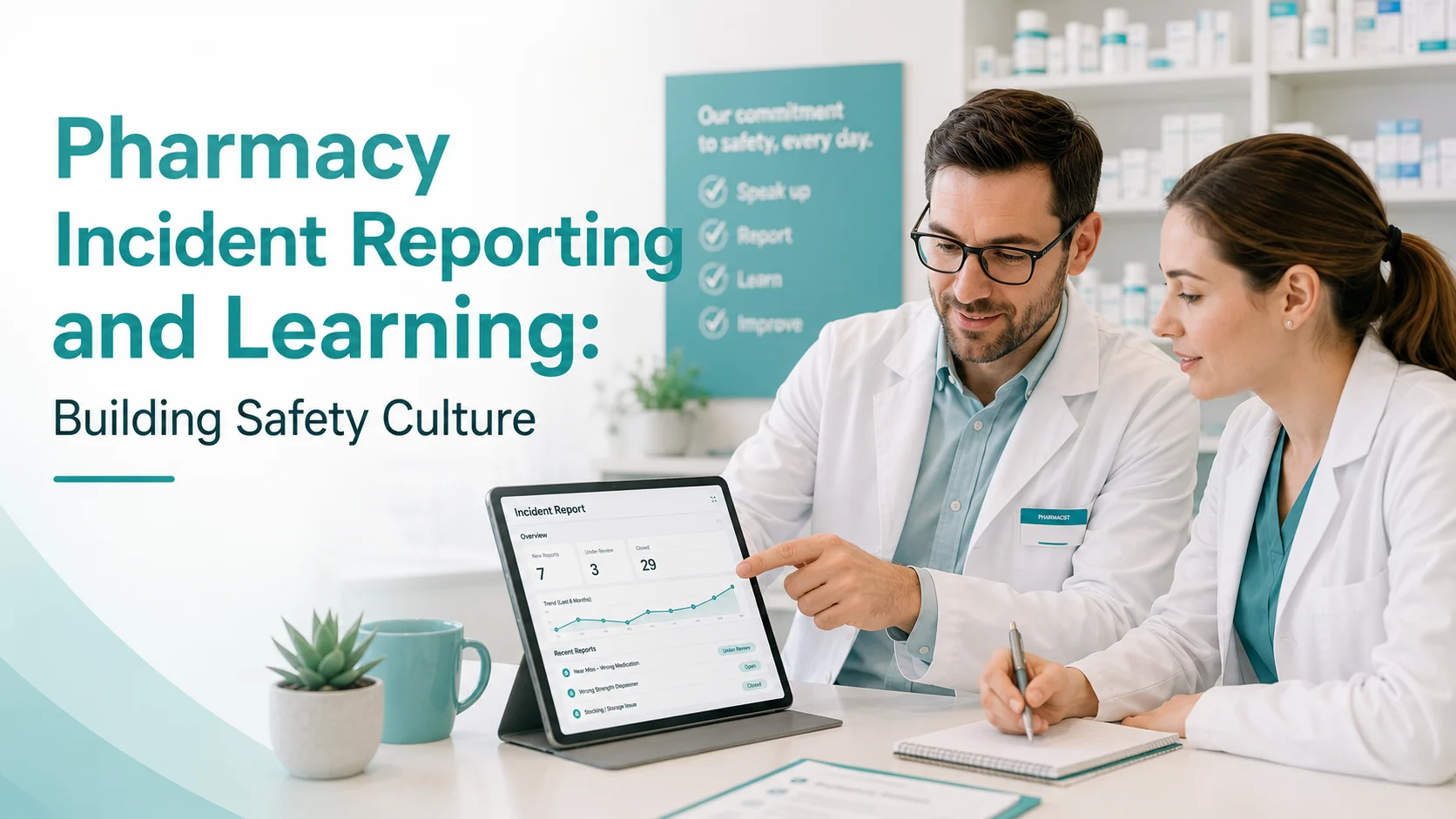
Pharmacy Incident Reporting and Learning: Building Safety Culture
Build effective incident reporting in pharmacy. Learn how to create reporting culture, investigate effectively, and turn incidents into learning opportunities.
Dispensing error caught at final check. Near miss. No patient harm. Relief all around.
But what happens next determines whether it happens again. Document and investigate, or sigh with relief and move on? Every incident, whether caught or not, contains learning opportunity.
Why Incident Reporting Matters
Learning Opportunity
Incidents reveal system weaknesses. Look-alike packaging. Confusing labelling. Workflow gaps. Staffing pressures. Each incident points to improvement opportunity.
Regulatory Requirement
GPhC expects pharmacies to have incident reporting systems. Serious incidents require notification. Documentation demonstrates governance. Learning must be evidenced.
Legal Protection
Documented incidents with investigation and learning demonstrate responsible practice. Undocumented patterns suggest negligence. Records protect if claims arise.
Creating Reporting Culture
No Blame Approach
Punitive responses suppress reporting. Staff hide errors rather than report them. Learning is lost. The same errors recur. Blame-free culture encourages honest reporting.
Easy Reporting
Complex forms discourage reporting. Make it simple. Quick to complete. Available when needed. Not a burden to document.
Visible Response
When staff see that reports lead to improvement, reporting increases. Share learning. Implement changes. Acknowledge contributions. Close the feedback loop.
Effective Investigation
Root Cause Analysis
Ask why repeatedly. Why did the error occur? Why did the check fail? Why was the system vulnerable? Keep asking until you find systemic causes, not just individual failure.
System Focus
Most errors have system contributors. Workload pressure. Inadequate checking process. Environmental distractions. Poor labelling. Fix systems, not just individuals.
Action Planning
Investigation should lead to action. What will change? Who is responsible? By when? How will effectiveness be measured?
Learning and Improvement
Share Learning
Discuss incidents in team meetings. Share anonymised learning across sites. Enable others to learn from every incident.
Track Trends
Individual incidents may seem random. Aggregated data reveals patterns. Same error type recurring. Same time of day. Same circumstances. Patterns point to systemic issues.
Build a Learning Organisation
Incident reporting is not about blame. It is about learning. Every reported incident is an opportunity to improve safety and prevent future harm.
RxSure includes incident reporting and tracking. Document incidents, investigate causes, plan actions, and track trends. Build a culture of learning.
Start your free trial and improve through learning.