
Payment Integration for Private Prescribing Services
Integrate payments into your private prescribing workflow. Learn about Stripe, PayPal, invoicing, and revenue tracking for pharmacist independent prescribers.
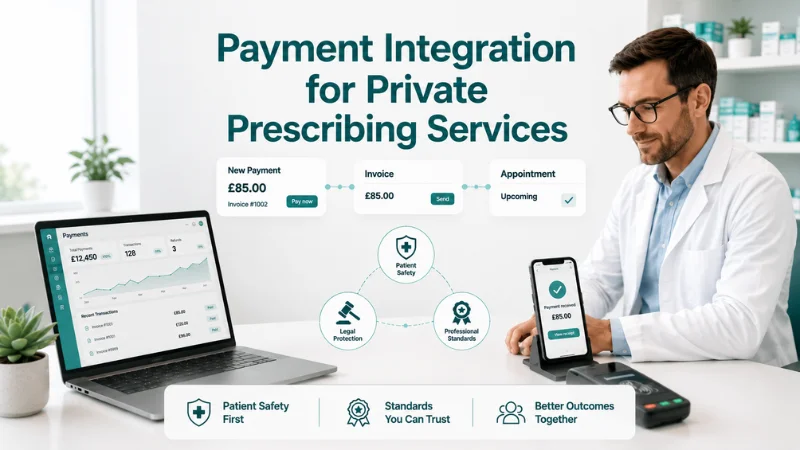
Running a private prescribing service means managing clinical consultations, patient records, regulatory compliance, and, critically, payments. Yet many pharmacist independent prescribers still rely on separate payment systems that create friction, errors, and administrative burden. If your payment workflow is disconnected from your prescribing platform, you are losing time and potentially losing revenue.
Integrated payment processing is no longer a luxury. It is a fundamental requirement for any modern private prescribing practice. From the moment a patient books a consultation to the point they receive their prescription, the financial transaction should be smooth, secure, and fully tracked. This guide explores how to integrate payments into your private prescribing workflow effectively.
Why Separate Payment Systems Create Problems
When your payment processing sits outside your prescribing platform, several issues arise. Manual reconciliation becomes a daily chore. You must cross-reference bank statements with appointment records, match payments to patients, and chase outstanding invoices individually. This is not just time-consuming, it is error-prone.
Separate systems also create a poor patient experience. A patient who books online, attends a consultation, and then receives a separate payment link or invoice via email feels the disconnect. It undermines the professional, simpler service you are trying to deliver. Patients expect the same smooth experience they get from other online services.
Furthermore, disconnected payment data makes financial reporting difficult. Understanding your revenue per service, per prescriber, or per time period requires manual data aggregation. This limits your ability to make informed business decisions about pricing, staffing, and service expansion.
Integrated Payment Options: Stripe, PayPal, and Beyond
The UK market offers several robust payment processing options suitable for healthcare services. Each has distinct advantages depending on your practice size and needs.
Stripe
Stripe is widely regarded as the gold standard for integrated payments. It offers smooth API integration, meaning your prescribing platform can process payments without the patient ever leaving your website. Stripe supports card payments, Apple Pay, Google Pay, and bank transfers. Transaction fees are transparent, typically 1.4% + 20p for UK cards. Stripe also provides excellent reporting dashboards and handles refunds gracefully.
PayPal
PayPal remains popular with patients who prefer not to enter card details directly. It offers buyer protection, which some patients value for healthcare services. PayPal Business accounts provide invoicing features, recurring billing, and integration with most booking platforms. However, PayPal fees can be slightly higher, and the redirect to PayPal during checkout can feel less smooth than Stripe.
Other Options
Square is excellent for practices that also take in-person payments, offering both card readers and online processing. GoCardless specialises in Direct Debit, ideal for subscription-based prescribing services. Worldpay and SumUp are also viable options, particularly for practices that prefer established banking-sector providers.
Setting Up Payment Workflows
The timing of payment collection significantly affects both your cash flow and patient experience. There are three primary models to consider.
Pre-Payment at Booking
Collecting payment when the patient books their consultation is the most efficient model. It eliminates no-shows (or at least ensures you are compensated for them), simplifies reconciliation, and reduces administrative follow-up. Patients pay upfront, attend their consultation, and receive their prescription, the financial element is already handled. This is the model most successful private prescribing services adopt.
Post-Consultation Payment
Some prescribers prefer to collect payment after the consultation, particularly when the outcome might vary. For example, if a consultation results in a referral rather than a prescription, you might charge a reduced consultation fee. Post-consultation payment requires more administrative follow-up but offers flexibility. Automated payment links sent immediately after the consultation help maintain cash flow.
Deposit Model
A hybrid approach collects a deposit at booking (typically 50%) with the remainder charged after the consultation. This reduces no-shows while allowing flexibility on the final charge. It works well for services where the consultation outcome genuinely affects the total cost.
Invoicing and Receipt Generation
Professional invoicing is essential for patient trust and your financial records. Every transaction should generate a clear, branded receipt that includes your practice details, the service provided, the date, and the amount charged. Automated receipt generation eliminates manual work and ensures consistency.
For patients claiming through private health insurance, detailed invoices are particularly important. Include your prescriber registration number, the clinical service code if applicable, and a clear description of the service. Platforms like RxSure can automate this process, generating professional invoices that patients can submit directly to their insurer.
Consider also offering patients a payment history portal where they can access all their previous receipts. This self-service approach reduces enquiries and demonstrates professional financial management.
Revenue Tracking and Financial Reporting
Integrated payment systems provide real-time revenue data that separate systems simply cannot match. You should be able to see, at a glance, your revenue by day, week, month, or custom period. Break this down by service type, prescriber, or patient category to identify trends and opportunities.
- Revenue per consultation type: Understand which services are most profitable and where to focus growth efforts
- Revenue per prescriber: For multi-practitioner practices, track individual contribution and identify training needs
- Refund rates: Monitor refunds as an indicator of patient satisfaction and service delivery issues
- Outstanding payments: Track unpaid invoices and automate follow-up reminders
- Average transaction value: Monitor pricing effectiveness and identify upselling opportunities for additional services
Export capabilities are essential for your accountant. Ensure your payment system can export transaction data in CSV or PDF format, compatible with common accounting software like Xero, QuickBooks, or FreeAgent.
PCI Compliance and Payment Security
Handling patient payment data carries serious security obligations. The Payment Card Industry Data Security Standard (PCI DSS) applies to any business that processes, stores, or transmits card data. Non-compliance can result in fines, increased transaction fees, and reputational damage.
The simplest way to achieve PCI compliance is to use a payment processor that handles card data on your behalf. Stripe, PayPal, and Square all provide PCI-compliant payment forms that mean sensitive card details never touch your servers. This approach, known as SAQ A, is the least burdensome compliance level and is appropriate for most prescribing practices.
Beyond PCI compliance, ensure your payment system uses strong customer authentication (SCA) as required by UK payment regulations. This typically means 3D Secure verification for card payments, adding an extra layer of security that protects both you and your patients. Never store card details on your own systems, and ensure all payment pages use HTTPS encryption.
Simplify Your Revenue
Payment integration is not merely a technical improvement, it is a business transformation. When payments flow seamlessly through your prescribing workflow, you reduce administration, improve cash flow, enhance patient experience, and gain the financial visibility needed to grow your practice.
RxSure provides integrated payment processing designed specifically for pharmacist independent prescribers, with automated invoicing, real-time revenue tracking, and full PCI compliance built in.
Explore RxSure’s integrated payment features and simplify your private prescribing revenue today.