

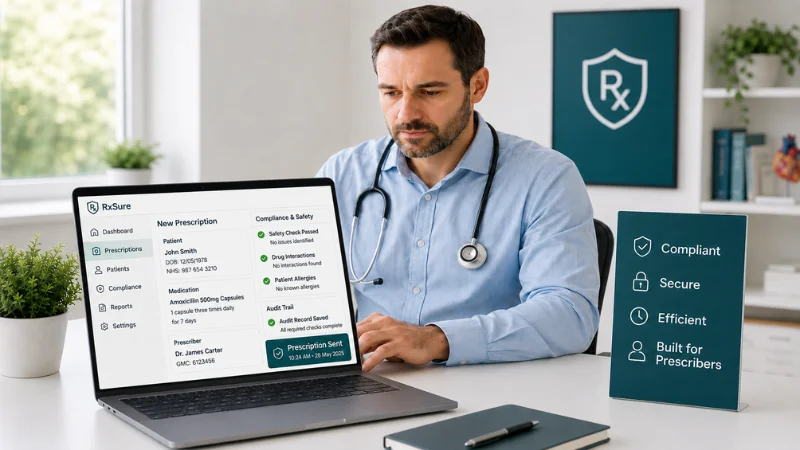
TL;DR: E-prescribing software for private practice in 2026 must balance compliance (Human Medicines Regulations 2012), usability (mobile-first, fast workflows), and economics (avoid per-Rx fees). This guide covers the specific features that matter, the regulatory requirements you cannot skip, and how to evaluate vendors without getting lost in marketing jargon.
The term “e-prescribing” covers a broad spectrum, from NHS Electronic Prescription Service (EPS) integration to standalone private prescription generation. If you are searching for e-prescribing software in 2026, the first question is: what type of prescribing are you doing?
This guide focuses on private prescribing, where an independent prescriber (pharmacist, GP, nurse, or dentist) issues private prescriptions outside the NHS EPS system. The requirements, regulations, and optimal technology are distinct from NHS e-prescribing, and conflating the two leads to choosing the wrong platform.
What “E-Prescribing” Means in Private Practice
In the private prescribing context, e-prescribing software handles:
- Prescription creation, generating a legally compliant private prescription with all mandatory fields per the Human Medicines Regulations 2012 (Regulation 217)
- Clinical decision support, drug interaction checks, allergy alerts, dose range verification
- Prescription transmission, sending the prescription electronically to a nominated pharmacy, printing for patient collection, or retaining for in-house dispensing
- Record keeping, maintaining a complete, auditable prescription history linked to patient clinical records
- Repeat prescribing, managing ongoing prescriptions for chronic conditions with appropriate review intervals
Unlike NHS EPS (which routes prescriptions through the NHS Spine to nominated pharmacies), private e-prescribing operates independently. This gives you flexibility but also places the compliance burden squarely on your shoulders.
Legal Requirements for Private Prescriptions
The Human Medicines Regulations 2012 specify what a valid private prescription must contain. Your e-prescribing software must generate prescriptions that include:
- The prescriber’s name, address, and professional registration number
- The date of the prescription
- The patient’s name and address
- The medicine name (approved/generic name preferred), form, and strength
- The quantity to be supplied or the number of days’ treatment
- Dosage directions
- The prescriber’s signature (electronic signatures are permitted for private prescriptions, confirmed by MHRA guidance)
For Schedule 2 and 3 Controlled Drugs, additional requirements apply under the Misuse of Drugs Regulations 2001, including quantity in words and figures, form, strength, and total quantity. Not all platforms support CD prescribing; verify this specifically if your service covers pain management, ADHD, or other areas involving controlled substances.
Feature Evaluation Framework
Score each platform against these categories. Weight them according to your specific practice needs:
Speed and Workflow Efficiency
A prescription should take under 60 seconds to generate for a straightforward repeat item. If the platform requires more clicks than a paper pad, it is adding friction rather than removing it. Evaluate:
- Number of clicks from “start prescription” to “signed and sent”
- Auto-population from patient history (previous prescriptions, saved medications)
- Quick-search for medicines by name, with auto-complete
- Template prescriptions for your most common items
- Mobile functionality, can you prescribe from a tablet during a home visit?
Safety Features
Clinical decision support is not optional for responsible e-prescribing:
- Drug-drug interaction checking, at minimum, flagging BNF-listed significant interactions
- Allergy alerts, cross-referencing prescribed medicines against the patient’s recorded allergies
- Dose range checking, warning when a prescribed dose falls outside the normal BNF range
- Duplicate therapy alerts, flagging when a patient is already on a medicine in the same class
- Override documentation, when you proceed despite an alert, the system should record your clinical rationale
Integration Capabilities
No platform operates in isolation. Evaluate how well the e-prescribing system connects with:
- Patient booking systems (or whether booking is built-in)
- Payment processing (Stripe, PayPal, card terminals)
- Video consultation tools (Whereby, Zoom, or native)
- SMS/email notification services (appointment reminders, prescription ready alerts)
- Accounting software (Xero, QuickBooks) for invoicing
Platforms like RxSure integrate these capabilities natively, booking, consultations, prescribing, and communications in one system, eliminating the integration headache.
2026 Trends Shaping E-Prescribing
Several developments are changing what prescribers should expect from their software:
- Mobile-first design, prescribers increasingly work from multiple locations. Platforms that only function on desktop computers are becoming a constraint.
- AI-assisted prescribing, emerging platforms offer AI-generated clinical summaries, automated coding, and decision support beyond basic interaction checking. Evaluate with caution, AI must support, not replace, clinical judgement.
- Patient self-service, patients expect to book, complete forms, and receive prescriptions digitally without phone calls or paper. Your platform should deliver this.
- Regulatory evolution, the MHRA’s evolving guidance on software as a medical device (SaMD) may affect clinical decision support tools. Choose a vendor actively managing their regulatory classification.
Red Flags During Vendor Evaluation
- “NHS accredited” claims for private prescribing, NHS accreditation (like GP IT Futures) is irrelevant for private platforms. It does not indicate quality for your use case.
- No live demo available, if you cannot test the actual platform before purchasing, question what they are hiding.
- Vague data hosting answers, “cloud-based” without specifying UK data centre locations and certifications is insufficient for health data.
- No drug database update schedule, BNF data changes regularly. Ask how often the formulary database is updated and whether updates are automatic.
- Required IT support for setup, a modern SaaS platform should not require an IT consultant to get you started. If it does, the UX is poor.
Frequently Asked Questions
Are electronic signatures legal on private prescriptions?
Yes. The MHRA has confirmed that electronic signatures are acceptable for private prescriptions. The Electronic Communications Act 2000 and the eIDAS Regulation (retained in UK law) both support the validity of electronic signatures. However, Schedule 2 and 3 Controlled Drug prescriptions still require a “wet” (handwritten) signature under current Misuse of Drugs Regulations, though this is under review.
Do I need NHS Spine connection for private prescribing?
No. The NHS Spine and Electronic Prescription Service (EPS) are for NHS prescriptions only. Private prescriptions operate independently. Your e-prescribing platform does not need, and should not claim to need, NHS Spine connectivity for private practice.
Can patients take an electronic prescription to any pharmacy?
A private prescription can be dispensed at any pharmacy. The format (paper or electronic) depends on the receiving pharmacy’s capabilities. Most platforms offer multiple output options: direct electronic transmission to a partnered pharmacy, PDF for the patient to present, or printed hard copy. The legal validity is in the prescription content, not the medium.
How often should the drug database be updated?
The BNF is updated monthly. MHRA drug safety alerts can emerge at any time. A responsible e-prescribing platform should update its formulary at minimum monthly, with emergency updates for safety alerts within 24-48 hours. Ask vendors for their update schedule and process, outdated drug data is a patient safety risk.
What happens if the platform goes down mid-consultation?
Business continuity planning is essential. Ask: what is the platform’s uptime SLA? What happens to in-progress prescriptions during an outage? Is there an offline fallback? RxSure maintains a 99.9% uptime target with automatic session preservation, if connectivity drops, your work is not lost.
References
- Human Medicines Regulations 2012 (SI 2012/1916). Part 12: Prescriptions. legislation.gov.uk
- Misuse of Drugs Regulations 2001 (SI 2001/3998). Regulation 15: Requirements for prescriptions. legislation.gov.uk
- MHRA. Guidance on Electronic Prescriptions. 2022.
- Electronic Communications Act 2000. legislation.gov.uk
- BNF (British National Formulary). NICE. bnf.nice.org.uk
Modern E-Prescribing, Built for Private Practice
RxSure handles prescriptions, consultations, booking, and records, one platform, flat £199/month, no per-Rx fees.
About this article: This article was prepared by the RxSure editorial team and is informed by publicly available UK healthcare guidance. Source references include GPhC, NICE, and BNF where cited. Content is reviewed periodically to reflect current information. This article is for general informational purposes and should not be relied upon as professional, medical, or regulatory advice. Last updated: 26 July 2026.


