

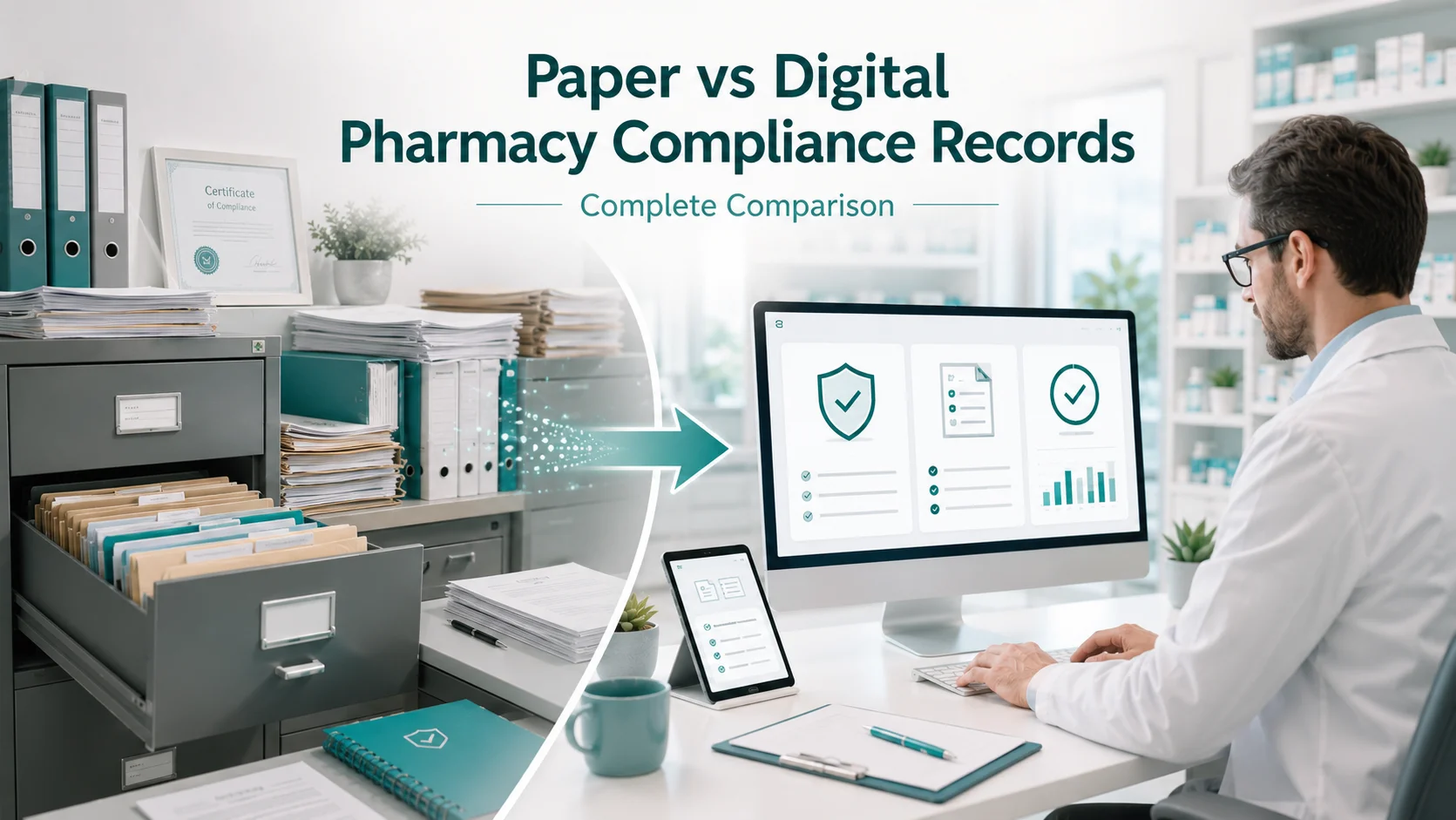
TL;DR: Compare paper and digital compliance record-keeping for pharmacies. Understand the advantages, disadvantages, and practical considerations for your compliance documentation.
Walk into most pharmacy back offices and you will find filing cabinets. Inside: staff folders, training records, certificates, policies, and procedures. Decades of documentation, carefully filed and maintained.
Paper has served pharmacy compliance well. It is tangible, requires no technology, and creates physical evidence of documentation. Many successful pharmacies have maintained excellent compliance using paper systems.
But the regulatory environment has changed. Documentation volumes have increased. Inspection expectations have evolved. The question is not whether paper can work – it is whether it is still the best approach.
Paper Record-Keeping
Advantages of Paper
Tangibility: Physical documents feel real and permanent. You can hold a certificate, file it in a folder, and retrieve it by touch.
Simplicity: No technology required. No software to learn. No passwords to remember. No system failures.
Familiarity: Everyone knows how to use paper. No training required.
Low direct cost: Paper, folders, and cabinets are inexpensive compared to software subscriptions.
Disadvantages of Paper
Retrieval time: Finding a specific document requires knowing where it is filed and physically searching. As volumes increase, retrieval time grows.
Single copy limitation: A paper document exists in one place. If that place is inaccessible, the document is unavailable.
Damage risk: Fire, water, decay, and rodents can destroy paper records permanently.
No automated alerting: Paper does not warn you about approaching deadlines.
Space requirements: Compliance documentation accumulates. Storage space becomes an ongoing cost.
Remote access impossible: Paper documents cannot be accessed from other locations.
Digital Record-Keeping
Advantages of Digital
Instant retrieval: Search by any attribute – name, date, type, content – and retrieve documents in seconds.
Multiple access: The same document can be accessed simultaneously from multiple locations by multiple people.
Automated alerting: Digital systems can monitor dates and generate automatic reminders.
Backup capability: Digital records can be duplicated across multiple locations, eliminating single-point loss risk.
Space efficiency: Millions of documents occupy minimal physical space.
Version control: Track document history, compare versions, ensure current documents are clearly identified.
Audit trails: Every access, change, and action can be logged automatically.
Disadvantages of Digital
Technology dependence: System failures, power outages, or internet problems can prevent access.
Learning requirement: Staff need training on new systems.
Ongoing costs: Software subscriptions and maintenance costs continue indefinitely.
Security responsibility: Digital records require cybersecurity attention.
Head-to-Head Comparison
Retrieval speed: Digital wins (seconds vs minutes). Automated alerts: Digital wins. Remote access: Digital wins. Backup capability: Digital wins. Setup cost: Paper wins. Technology requirement: Paper wins. Disaster recovery: Digital wins. Audit trail: Digital wins. Inspection readiness: Digital wins.
Regulatory Considerations
The GPhC does not mandate paper or digital records. Requirements focus on records being accurate, complete, accessible when needed, retained appropriately, and protected from unauthorised access. Digital records meeting these requirements are fully acceptable.
Similarly, CQC requires evidence of compliance but does not specify format. Digital evidence presented during inspections is commonplace and accepted.
The Future Is Digital
Regulatory expectations continue evolving toward digital evidence. Inspection processes increasingly involve digital submission. Pharmacies investing in digital compliance infrastructure now are better positioned for future regulatory requirements.
RxSure provides modern digital compliance management designed specifically for UK pharmacies. Our platform combines systematic record-keeping with digital accessibility, automated monitoring, and instant reporting.
Start your free trial and move beyond paper.
About this article: This article was prepared by the RxSure editorial team and is informed by publicly available UK healthcare guidance. Source references include GPhC, NICE, and BNF where cited. Content is reviewed periodically to reflect current information. This article is for general informational purposes and should not be relied upon as professional, medical, or regulatory advice. Last updated: 4 July 2026.


