

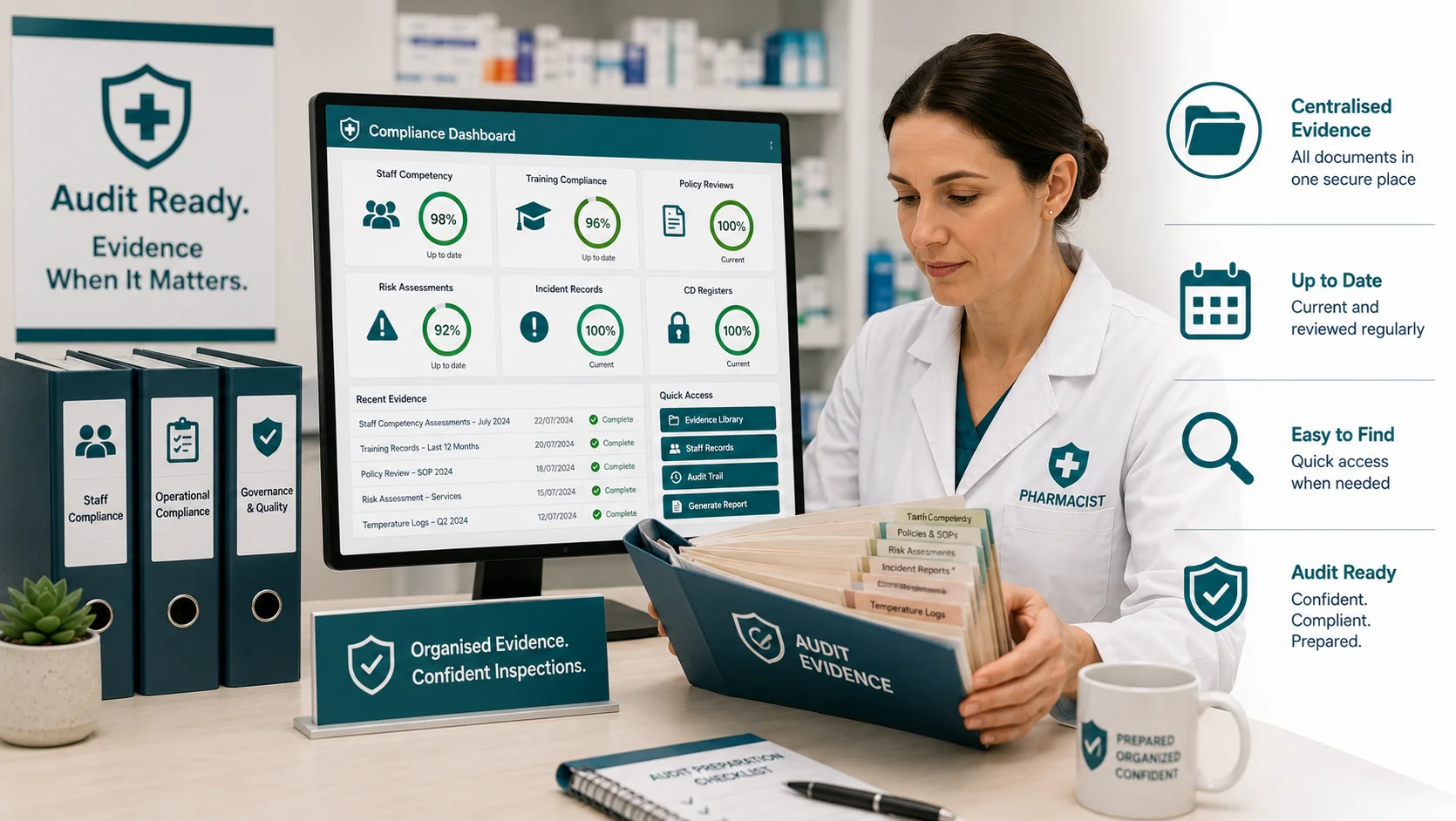
TL;DR: Master pharmacy audit preparation with our comprehensive guide to evidence management. Learn what auditors expect, how to organise evidence, and achieve confident inspections.
Can you show me evidence of staff competency assessments for the past twelve months?
The inspector question hangs in the air. You know the assessments happened. You are fairly sure they were documented. But where exactly are they? In which folder? On whose computer? In what format?
The difference between confident inspections and stressful scrambles often comes down to evidence management. Not whether you are compliant, but whether you can prove it quickly and comprehensively.
Understanding Audit Evidence Requirements
What Auditors and Inspectors Expect
Modern pharmacy audits require evidence that is complete (covering all required elements), current (up-to-date with recent dates), accessible (retrievable quickly when requested), organised (logically structured for navigation), and verifiable (authentic with audit trails).
Types of Evidence Required
Staff compliance evidence: DBS certificates and checks, professional registration verification, training completion records, competency assessment outcomes, and supervision documentation.
Operational compliance evidence: Temperature monitoring logs, incident and near-miss records, controlled drugs registers, responsible pharmacist records, and cleaning and maintenance logs.
Governance evidence: Policy documents (current versions), risk assessments, meeting minutes, action plans and progress, and quality improvement activities.
Common Evidence Failures
Failure 1: Evidence Exists But Cannot Be Found
Documentation completed correctly, but filed in unpredictable locations. Personal folders on individual computers. Email attachments never downloaded. Physical files in unmarked boxes.
Failure 2: Evidence Is Outdated
Policy reviewed three years ago. Training records from previous system. Risk assessments predating service changes.
Failure 3: Evidence Is Incomplete
Some staff files missing documents. Training records without completion dates. Assessments without outcomes recorded.
Building an Evidence Management System
Principle 1: Central Repository
All compliance evidence should have a designated home. Not scattered across personal folders, email accounts, and various systems. One location where evidence lives.
Principle 2: Logical Structure
Organise evidence to match how it will be requested. By staff member for personnel files. By compliance area for thematic evidence. By time period for historic records.
Principle 3: Consistent Naming
Predictable file naming enables retrieval. Include key identifiers in names. Use consistent date formats. Avoid generic names.
Achieve Audit Confidence
Audit preparation should not be a panic. With good evidence management, audits become opportunities to demonstrate the compliance you maintain every day.
RxSure makes evidence management simple. Upload documents, track expiry dates, generate evidence packs. When inspectors ask, you have answers ready.
Start your free trial and master audit preparation.
About this article: This article was prepared by the RxSure editorial team and is informed by publicly available UK healthcare guidance. Source references include GPhC, NICE, and BNF where cited. Content is reviewed periodically to reflect current information. This article is for general informational purposes and should not be relied upon as professional, medical, or regulatory advice. Last updated: 4 July 2026.