

DBS Certificate Management for Pharmacy Staff: Complete Guide
Comprehensive guide to managing DBS certificates for pharmacy staff. Covers check levels, renewal requirements, Update Service, and compliance best practices.
Pharmacies occupy a unique position in healthcare, providing public access to medicines and health services without appointment. This accessibility, while vital for patients, creates safeguarding responsibilities that demand rigorous staff vetting.
Disclosure and Barring Service DBS checks are a fundamental component of pharmacy staff management. They protect vulnerable patients, meet regulatory requirements, and demonstrate your commitment to safe recruitment practices.
Yet DBS management presents significant challenges. Certificates arrive at employee home addresses. There is no central employer access to verify status. The DBS Update Service offers continuous checking but requires staff consent and employer understanding. Different roles require different check levels.
This guide cuts through the complexity and provides practical guidance for managing DBS requirements across your pharmacy team.
Understanding DBS Check Levels
Basic DBS Check
The basic check reveals only unspent convictions held on the Police National Computer. This is the minimum level of check and is available to anyone for any purpose.
Suitable for:
- Administrative staff with no patient contact
- Cleaners and maintenance personnel
- Delivery drivers depending on access
Not suitable for:
- Any role with regular patient interaction
- Staff handling confidential patient information
- Roles involving medicines access
Standard DBS Check
The standard check includes spent and unspent convictions, cautions, reprimands, and warnings. It is available for positions listed in the Rehabilitation of Offenders Act 1974 Exceptions Order 1975.
Suitable for:
- Medicines counter assistants
- Dispensary assistants
- Customer service roles with patient interaction
Enhanced DBS Check
Enhanced checks include everything in the standard check plus any additional information held by local police forces that is deemed relevant to the role.
Suitable for:
- Pharmacy technicians
- Trainee pharmacists
- Supervisor roles
- Staff involved in clinical services
Enhanced DBS with Barred List Checks
The highest level of check includes all enhanced check information plus a search of the DBS barred lists for adults, children, or both.
Suitable for:
- Pharmacists
- Staff working with vulnerable adults
- Staff providing services to children
- Vaccination service staff
- Any role defined as regulated activity
Determining the Right Level of Check
The appropriate check level depends on the role activities, not its job title. Consider the following questions:
Does the role involve regulated activity?
Regulated activity with children includes unsupervised activities teaching, training, or supervising children, and providing health services to children.
Regulated activity with adults includes providing healthcare, personal care, and assistance with daily living.
If yes: Enhanced DBS with relevant barred list check required.
Does the role have regular patient contact?
Regular is defined as occurring more than once a month, or involving direct one-to-one contact.
If yes: Enhanced DBS check appropriate.
Does the role access confidential patient information?
Including access to PMR systems, prescription records, or patient consultations.
If yes: Minimum standard DBS check required. Consider enhanced depending on access level.
DBS Certificates: What They Are and Are Not
Key Facts About DBS Certificates
- No expiry date: DBS certificates are valid only at the time of issue
- Employer cannot access: Certificates are sent to the individual, not the employer
- Personal document: Belongs to the individual, not the employer
- Portability: Can be shown to multiple employers but represents point-in-time check
Common Misconceptions
Misconception: This DBS certificate is valid for three years.
Reality: DBS certificates have no validity period. The three-year renewal is best practice, not regulatory requirement. A certificate only confirms status at the issue date.
Misconception: Once we have seen the certificate, we are compliant.
Reality: You should verify the certificate is genuine, record the details, and make a risk-based decision about acceptability. You may need to request a new check if concerns arise.
Misconception: We can keep a copy of the DBS certificate on file.
Reality: DBS code of practice recommends not retaining certificate copies longer than six months. Record the certificate number, issue date, and check level instead.
The DBS Update Service
How It Works
The DBS Update Service allows certificate holders to subscribe at 13 pounds per year to a service that:
- Keeps their certificate current
- Allows employers to check for new information
- Enables portability between employers
- Reduces need for repeat applications
Employer Benefits
With employee consent, employers can perform status checks through the Update Service:
- Instant verification: Check if certificate is still current
- No cost per check: Free checks after initial registration
- Regular monitoring: Can check as frequently as needed
- Reduced administration: No need to process new applications
Implementation Considerations
To use the Update Service effectively:
- Require subscription: Make Update Service subscription a condition of employment
- Obtain consent: Staff must consent to employer checking their status
- Regular checking: Establish a schedule for periodic checks, recommend monthly or quarterly
- Document checks: Record when checks were performed and outcomes
Building Your DBS Management System
New Starter Process
- Determine check level: Based on role assessment
- Initiate check: Use an umbrella body or registered organisation
- Request Update Service: Require subscription as condition of passing probation
- Verify certificate: Review original certificate in person
- Record details: Log certificate number, issue date, check level
- Risk assess: Consider any disclosed information against role requirements
- Make employment decision: Based on risk assessment outcome
Ongoing Management
- Update Service checks: Regular status verification for subscribed staff
- Renewal schedule: Three-yearly renewal for non-Update Service certificates
- Role changes: Reassess check level if role changes
- Concerns: Process for initiating new check if concerns arise
Compliance Best Practices
Create a DBS Policy
Your DBS policy should cover:
- Which roles require which level of check
- Process for initiating and managing checks
- Update Service requirements
- Storage and retention of information
- Risk assessment of disclosed information
- Ongoing monitoring schedule
- Response to Update Service changes
Maintain Accurate Records
For each staff member, record:
- Check level obtained
- Certificate number
- Issue date
- Update Service subscription status
- Date of last Update Service check
- Next action required
- Any risk assessments conducted
Common DBS Management Challenges
Challenge 1: Staff Reluctant to Share Certificates
Solution: Explain the requirement clearly during recruitment. Make viewing and recording the certificate a condition of starting work. Reassure staff about confidentiality and appropriate use.
Challenge 2: Inconsistent Renewal Tracking
Solution: Implement a centralised tracking system with automatic alerts. Assign clear responsibility for DBS management. Include DBS status in regular compliance reviews.
Challenge 3: Update Service Adoption
Solution: Offer to pay the annual subscription fee. Thirteen pounds is minimal investment. Make subscription a probation condition. Explain benefits to staff including portability and no repeat applications.
Challenge 4: Locum and Bank Staff
Solution: Require DBS verification before first shift. Accept Update Service checks from other employers. Maintain records of locum DBS status.
Digital DBS Management
Modern pharmacy management platforms can transform DBS compliance:
- Automated tracking: System monitors check dates and generates renewal alerts
- Staff self-service: Team members upload certificate details directly
- Update Service integration: Schedule automatic status checks
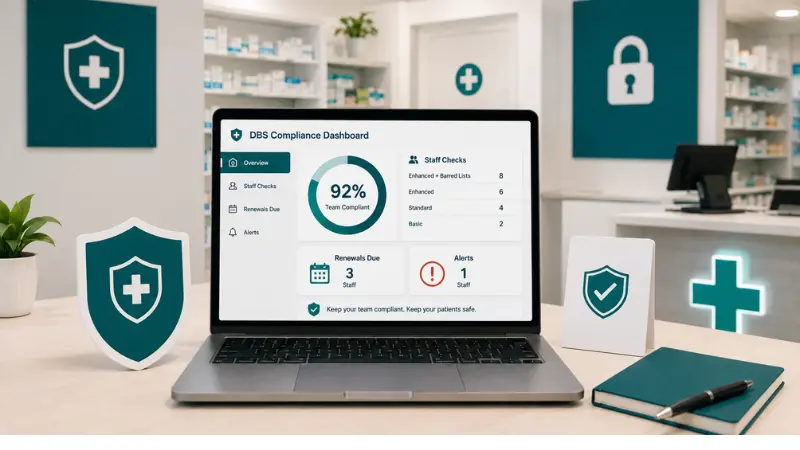
- Compliance dashboard: Real-time visibility of team DBS status
- Audit trail: Complete record of all checks and verifications
Protect Your Team and Patients
Effective DBS management is not just about compliance. It is about creating a safe environment for patients and staff. The effort invested in proper vetting and ongoing monitoring demonstrates your commitment to safeguarding.
RxSure compliance tracking includes comprehensive DBS management features. Track all staff DBS status, set renewal reminders, record Update Service checks, and maintain the audit trail inspectors expect.
Start your free trial and simplify your DBS management today.