
TL;DR: Discover how digital health companies integrate private prescribing into their platforms via API, white-label, and embedded models in the UK market.
The pharmacy software integration UK market has undergone a transformation that few predicted even three years ago. Digital health companies, from telehealth startups to established wellness platforms, are racing to embed clinical prescribing capabilities directly into their products. The reasoning is straightforward: patients expect smooth, end-to-end healthcare journeys, and a platform that can take them from symptom assessment through to a private prescription delivery holds an enormous competitive advantage.
But how exactly do digital health companies achieve this? What does the technical architecture look like, and what regulatory hurdles must be cleared before a single prescription can be issued through a third-party platform? This guide breaks down the integration landscape for CTOs, product managers, and digital health founders exploring private prescribing as a platform capability.
The UK Digital Health Market: Why Prescribing Integration Matters Now
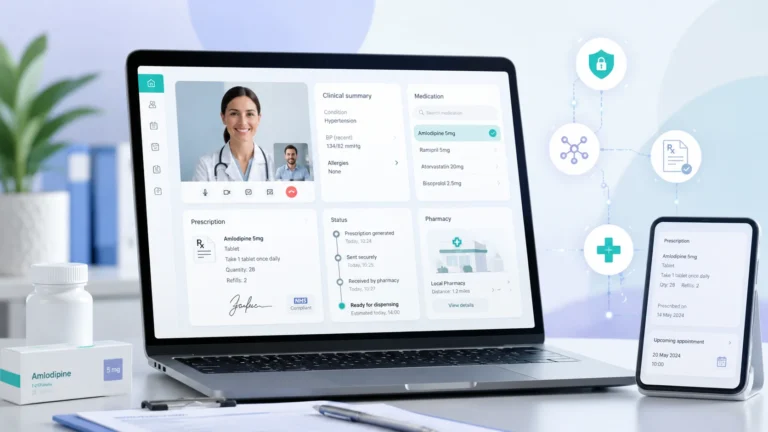
Electronic prescribing software has become essential for UK healthcare professionals who issue private prescriptions, replacing handwritten paper forms with secure digital workflows that reduce prescription errors, speed up consultations, and create complete audit trails. In the private prescribing sector, where prescriptions fall outside the NHS Electronic Prescription Service, practitioners need dedicated e-prescribing platforms that handle the entire workflow from patient assessment through medication selection, dosage calculation, prescription generation, and dispensing verification. The key advantages of e-prescribing over paper-based systems include elimination of illegibility errors which account for approximately ten per cent of prescription-related incidents, automatic drug interaction and contraindication checking against the patient’s medication history, structured prescription formats that comply with GPhC and CQC requirements, digital signatures with tamper-proof verification, and searchable records that simplify clinical audits and regulatory inspections. Modern e-prescribing platforms such as RxSure integrate prescription generation into a broader workflow that also covers patient booking, clinical consultations, and payment processing.
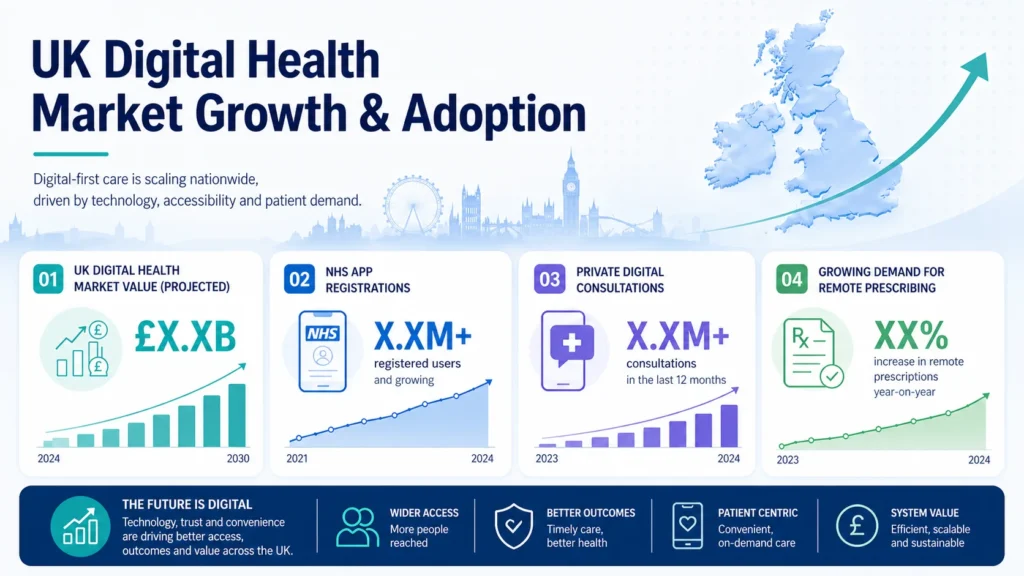
The UK digital health market is projected to reach £11.8 billion by 2027, according to Statista research published in early 2025. Within that market, remote prescribing and pharmacy services represent one of the fastest-growing segments, driven by patient demand and NHS capacity constraints that show no sign of easing.
Consider the numbers. NHS England reported that 36.8 million patients were registered for NHS App services by March 2025, demonstrating widespread public comfort with digital healthcare. The NHS Long Term Plan committed £4.2 billion to digital transformation between 2019 and 2024, and subsequent spending reviews have maintained this trajectory. Meanwhile, private digital health platforms processed an estimated 4.7 million consultations in 2024, up 38% year-on-year according to LaingBuisson market intelligence.
For digital health companies, the question is no longer whether to offer prescribing, it is how quickly they can bring it to market without compromising patient safety or regulatory compliance.
Technical Architecture: How Prescribing Gets Embedded
Choosing the right e-prescribing software requires evaluating several critical factors beyond basic prescription generation capability. The platform should include a comprehensive medication database covering the full British National Formulary with automatic dosage guidance, drug interaction checking, and allergy alerts based on the patient’s recorded history. Integration with the clinical consultation workflow is essential so that prescribing decisions are documented within the context of the patient assessment, creating a complete clinical record rather than an isolated prescription. Compliance features should include real-time audit trail logging of every prescribing action, controlled drug register functionality where applicable, and the ability to generate regulatory reports for GPhC inspections. The pricing model matters significantly for independent practitioners: per-prescription fee models can cost five to fifteen pounds per consultation, while flat-rate platforms such as RxSure charge a fixed monthly fee regardless of prescription volume. Finally, the platform should support both in-person and remote prescribing workflows with integrated video consultation capability.
API-First Integration Models
The most common approach for digital health companies seeking prescribing capabilities is API integration with a licensed prescribing platform. Rather than building prescribing infrastructure from scratch, which requires GPhC licensing, clinical governance frameworks, and Cyber Essentials Plus certification at minimum, companies connect to an existing platform via RESTful APIs.
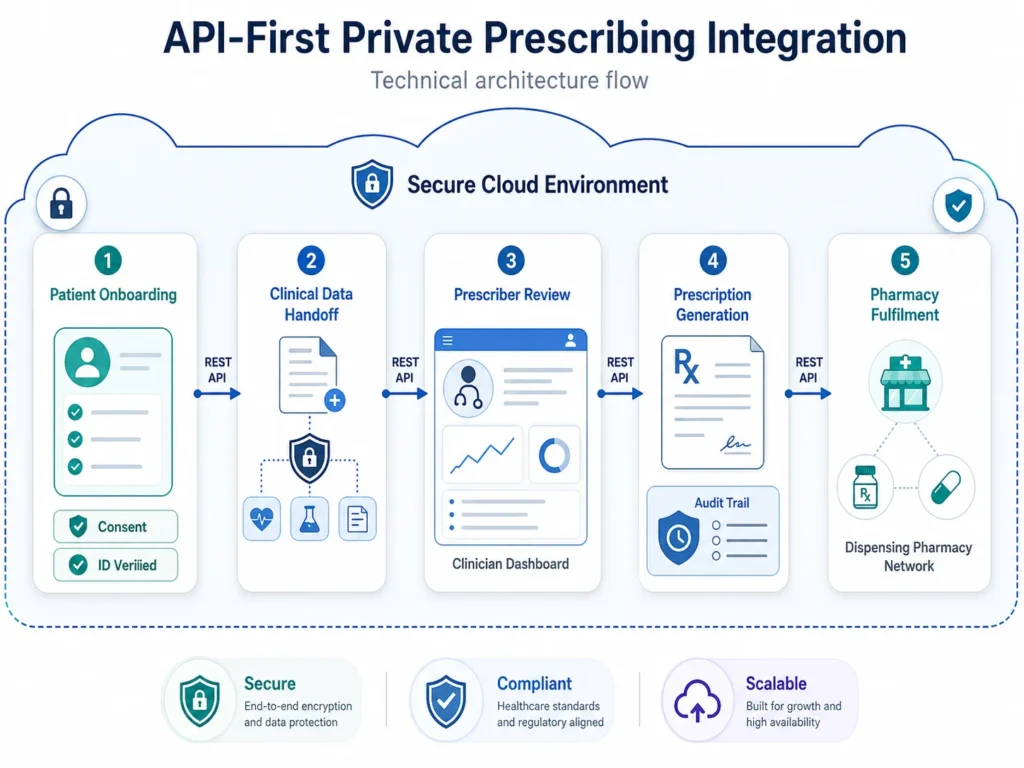
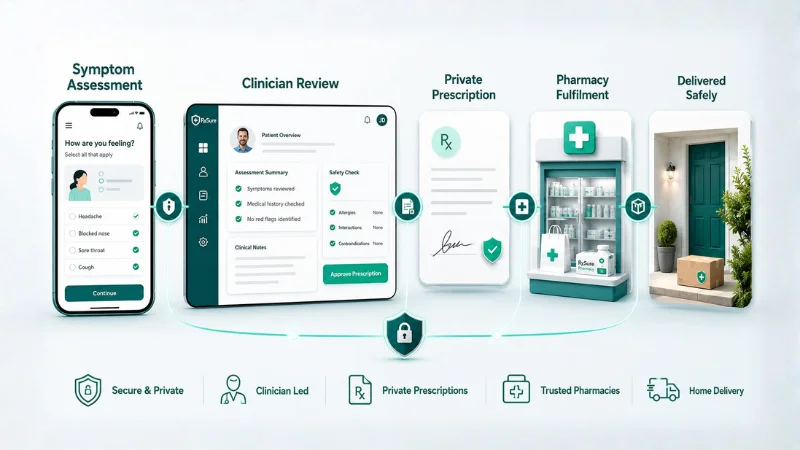
A typical integration flow looks like this:
- Patient onboarding: The host platform captures demographics, ID verification, and consent via its own UI
- Clinical handoff: Structured clinical data is passed via API to the prescribing platform
- Prescriber review: A registered independent prescriber reviews the case within the embedded platform
- Prescription generation: If clinically appropriate, a private prescription is generated with full audit trail
- Fulfilment: The prescription routes to a dispensing pharmacy, either the company’s own or a partner network
Platforms like RxSure offer this kind of API-first architecture specifically designed for B2B integration scenarios, enabling digital health companies to embed prescribing without building the clinical and regulatory infrastructure themselves.
White-Label vs Embedded Widget vs Full API
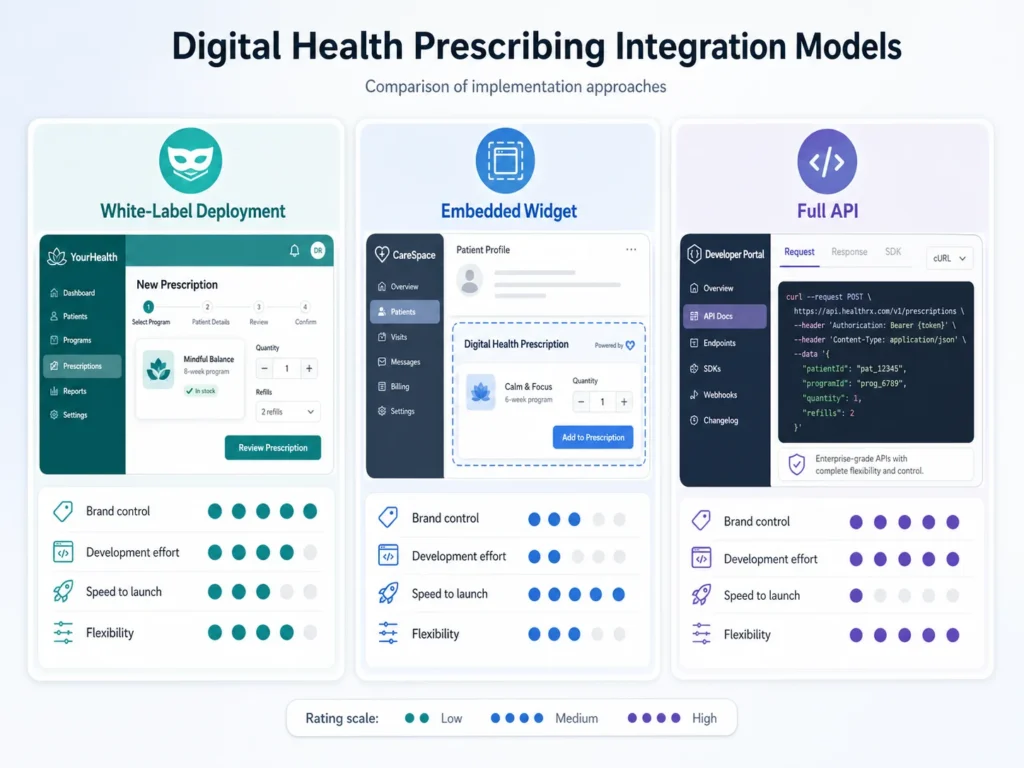
Integration depth varies considerably across the market. Three primary models exist:
- White-label deployment: The prescribing platform runs entirely under the partner’s brand. Patients never see the underlying technology provider. This requires the deepest integration but delivers the most smooth user experience.
- Embedded widget: A prescribing interface loads within an iframe or web component on the partner’s platform. Faster to implement but with less brand control.
- Full API: The partner builds their own front-end entirely, calling prescribing APIs for clinical decisions and prescription generation. Maximum flexibility, but requires significant development resource.
Regulatory Requirements for Prescribing Integration
This is where many digital health companies underestimate complexity. Embedding prescribing capabilities does not simply mean plugging in an API, it means operating within one of the most regulated sectors in UK healthcare.
GPhC and CQC Registration
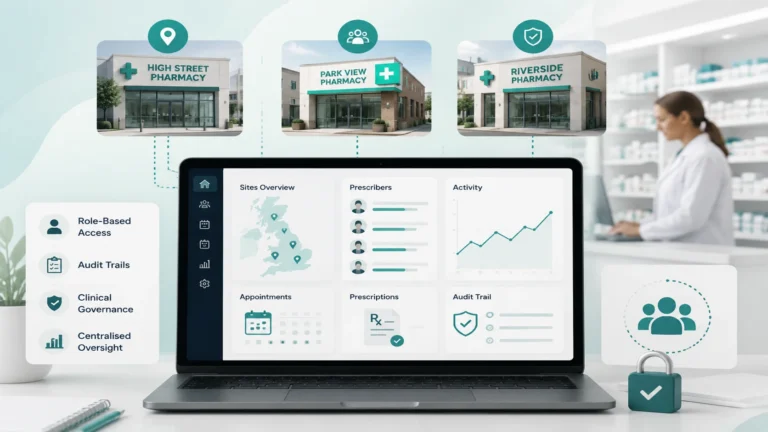
Any entity providing prescribing services must operate under appropriate GPhC registration (for pharmacy services) or CQC registration (for clinical services in England). The digital health company itself may not need direct registration if it partners with a registered provider, but the governance arrangements must be documented and defensible.
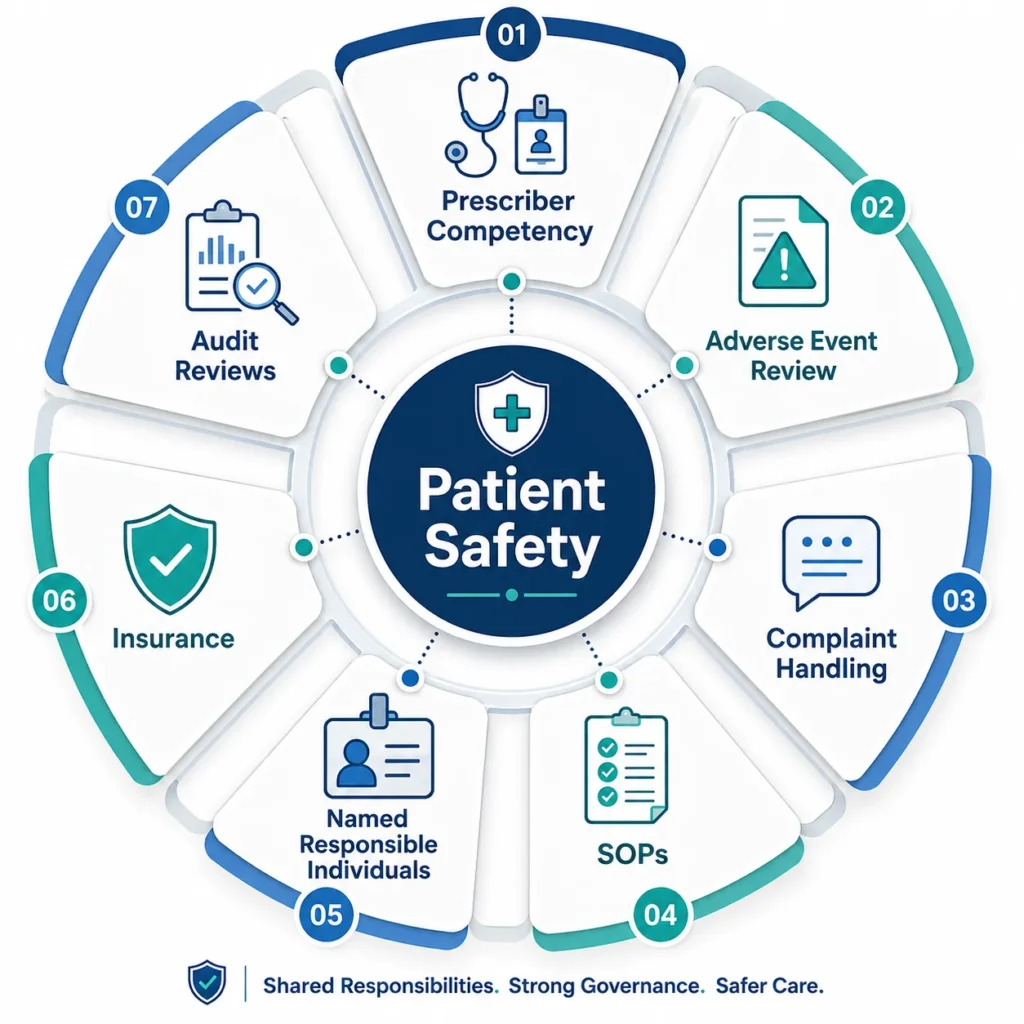
The GPhC published updated guidance on online pharmacy services in 2023, emphasising that technology partners bear shared responsibility for patient safety outcomes even when they are not the registered provider. This means digital health companies cannot simply absolve themselves by outsourcing to a licenced partner, they must demonstrate active governance participation.
Data Protection and Information Governance
Health data falls under UK GDPR’s special category provisions, requiring explicit consent and a lawful basis for processing. When data flows between a host platform and a prescribing partner, both parties typically act as joint data controllers or establish a clear controller-processor relationship. The ICO expects a Data Protection Impact Assessment for any new health data processing activity, and cross-border data flows (even to cloud hosting in the EU) require Standard Contractual Clauses post-Brexit.
Cyber Essentials Plus certification has become a de facto minimum for any organisation handling NHS or private health data. Many prescribing platforms, including RxSure, maintain this certification as a baseline requirement for integration partnerships.
Clinical Governance Frameworks
An integration partnership must define clear clinical governance responsibilities. Who reviews adverse events? Who manages prescriber competency assessments? Who handles patient complaints that span both platforms? These questions require documented Standard Operating Procedures and named responsible individuals, typically a Superintendent Pharmacist for pharmacy services or a Clinical Director for medical services.
Real-World Integration Patterns in the UK Market
Several categories of digital health company have already embedded prescribing capabilities successfully:
Telehealth Platforms
Companies offering video or async consultations have been the earliest adopters. Their business model already includes clinical assessment, adding prescribing closes the patient journey loop and dramatically improves conversion rates. Industry data suggests that telehealth platforms offering integrated prescribing see 2.4x higher patient retention than those requiring external prescription fulfilment.
Corporate Wellness Providers
Employee health platforms are increasingly embedding prescribing for common conditions, particularly smoking cessation, weight management, and sexual health. The corporate wellness market in the UK reached £2.1 billion in 2024 (IBIS World), and prescribing integration allows platforms to demonstrate measurable health outcomes to employer clients.
Condition-Specific Apps
Vertical health apps focused on single conditions (dermatology, mental health, menopause) use prescribing integration to become full-stack care providers. Rather than referring patients elsewhere for medication, they retain the entire clinical relationship within their platform.
Implementation Timeline: What to Expect
Based on typical UK market integrations, digital health companies should budget the following timelines:
- Discovery and scoping: 2-4 weeks (regulatory mapping, technical assessment, commercial alignment)
- API integration development: 6-10 weeks (depending on integration depth)
- Clinical governance setup: 4-6 weeks (SOPs, named persons, insurance arrangements)
- Testing and UAT: 3-4 weeks (including simulated prescribing scenarios)
- Regulatory review and sign-off: 2-4 weeks
- Soft launch: 1-2 weeks (limited patient cohort)
Total time from initial conversation to live prescribing: typically 18-30 weeks. Companies that have completed this process describe the regulatory and governance setup as the most time-intensive element, not the technical integration itself.
Cost Considerations for Platform Integrators
Costs vary dramatically depending on integration model, but typical ranges for UK digital health companies include:
- Integration setup fee: £5,000 – £25,000 (one-time, depending on complexity)
- Monthly platform access: £500 – £3,000 (depending on volume tier)
- Per-consultation fee: £3 – £12 (prescriber review cost)
- Compliance and governance: £2,000 – £8,000 per annum (audits, DPO, named persons)
These figures compare favourably to building in-house, which typically requires £300,000-£600,000 in first-year investment before a single prescription is issued. For a detailed breakdown of integration pricing models, visit our partnership pricing page.
Choosing the Right Prescribing Integration Partner
Not all prescribing platforms are built for B2B integration. When evaluating potential partners, digital health companies should assess:
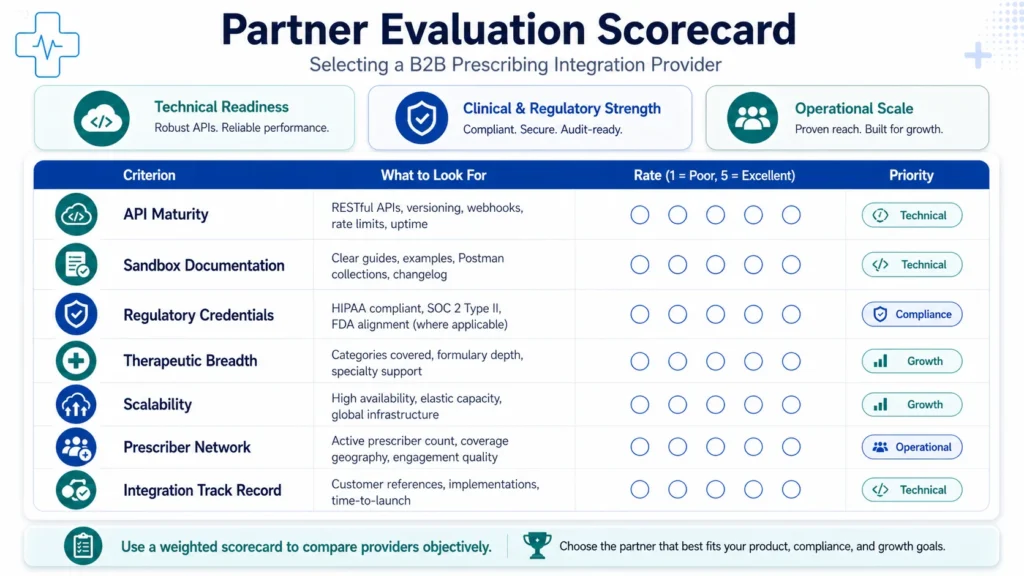
- API maturity: Is there comprehensive API documentation? What about sandbox environments for development?
- Regulatory credentials: GPhC registration, CQC rating, Cyber Essentials Plus, ISO 27001
- Clinical breadth: How many therapeutic areas are supported? Can the platform handle your specific use cases?
- Scalability: What are the API rate limits? Can the platform handle your projected volume?
- Prescriber network: Does the platform maintain its own prescriber workforce, or must you supply your own?
- Track record: How many B2B integrations are live? What is the average go-live timeline?
Sources & References
- General Pharmaceutical Council. Standards for Pharmacy Professionals. GPhC, 2024.
- National Institute for Health and Care Excellence. NICE Guidelines. NICE, 2024.
- British National Formulary. BNF Online. NICE, 2024.
- Information Commissioner’s Office. Guide to UK GDPR. ICO, 2024.
Frequently Asked Questions
Do we need our own GPhC registration to integrate prescribing into our platform?
Not necessarily. If you partner with a GPhC-registered prescribing platform, the prescribing activity operates under their registration. However, your company will still need to demonstrate appropriate governance arrangements, and the GPhC expects technology partners to actively participate in patient safety oversight. The specifics depend on your integration model, a white-label deployment may require different arrangements than a simple API integration.
How long does a typical prescribing integration take from contract to go-live?
Most UK digital health companies achieve go-live within 18-30 weeks. The technical API integration is often the fastest element (6-10 weeks), while establishing clinical governance frameworks and completing regulatory reviews typically takes longer. Companies with existing CQC or GPhC relationships can sometimes accelerate this timeline.
What happens if a prescriber declines to prescribe for one of our platform users?
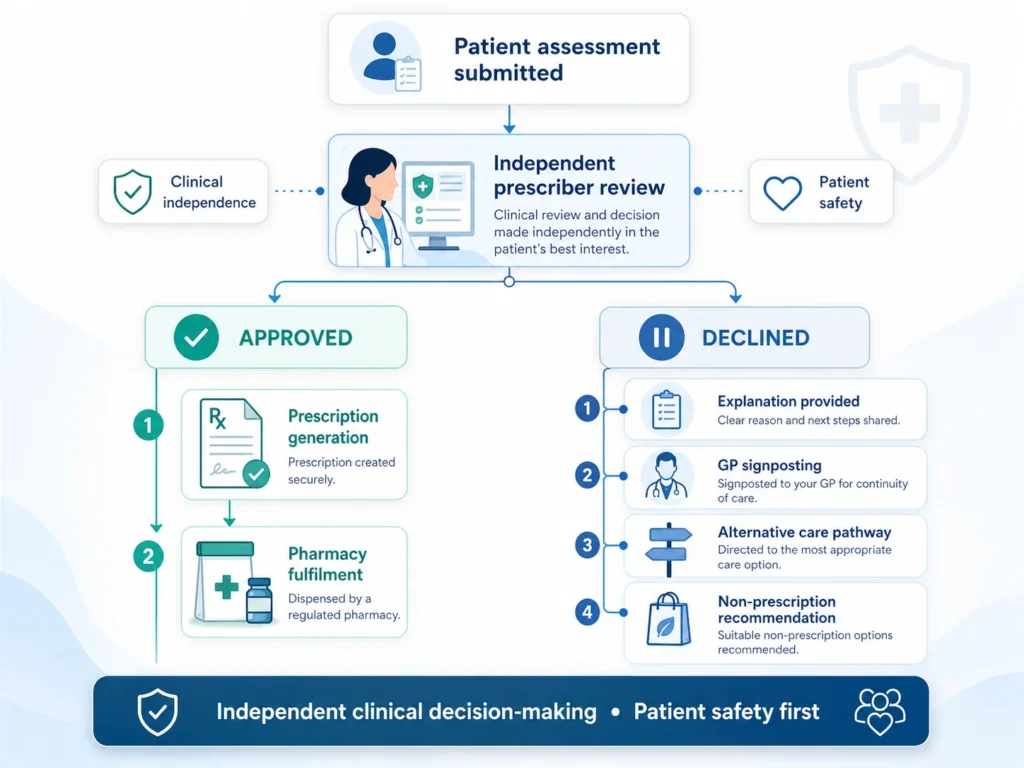
Clinical independence is non-negotiable in UK prescribing regulation. Prescribers must always retain the right to decline prescribing if clinically inappropriate. Your platform should be designed to handle this gracefully, providing alternative care pathways, signposting to GP services, or offering non-prescription alternatives. Conversion rates for well-designed platforms typically sit between 70-85%, meaning some level of decline is expected and healthy.
Can we use prescribing integration for NHS-commissioned services or only private prescriptions?
Most B2B prescribing integrations operate in the private sector, where the regulatory pathway is more straightforward. However, some platforms are exploring NHS-commissioned pathways, particularly for services like smoking cessation and weight management where NHS funding is available via community pharmacy contracts. This typically requires additional compliance with NHS Digital standards and DCB0129 clinical safety requirements.

Ready to explore prescribing integration for your platform? If you are a telehealth startup, a corporate wellness provider, or an established digital health company looking to expand your clinical offering, RxSure can help you understand the integration landscape. Visit our partners page to learn more about B2B integration models, or get in touch directly to discuss your specific requirements with our integration team.
About this article: This article was prepared by the RxSure editorial team and is informed by publicly available UK healthcare guidance. Source references include GPhC, NICE, and BNF where cited. Content is reviewed periodically to reflect current information. This article is for general informational purposes and should not be relied upon as professional, medical, or regulatory advice. Last updated: 26 July 2026.