

GP Communication for Pharmacists: Building Effective Relationships
Master GP communication skills for pharmacy practice. Learn how to make effective interventions, build professional relationships, and improve patient care collaboratively.

Every day, pharmacists identify prescription issues requiring prescriber input. Drug interactions, inappropriate doses, contraindications, unclear directions-all need resolution before medication reaches patients.
Yet the communication itself often determines outcome more than the clinical concern. A poorly communicated intervention may be dismissed. A well-communicated one prompts appropriate change. Professional relationships built over time make future communications easier.
Why GP Communication Matters
Private prescribing services delivered through UK community pharmacies and clinics have expanded rapidly in recent years, driven by the growing number of pharmacist independent prescribers, increasing patient demand for accessible healthcare outside traditional GP pathways, and the development of digital platforms that simplify clinical governance and regulatory compliance. The General Pharmaceutical Council has supported this expansion by maintaining clear standards for prescribing practice while allowing practitioners to develop their clinical scope based on competence and training. For practitioners, the key to successful private prescribing is combining clinical expertise with efficient operational processes that ensure every consultation is properly documented, every prescription meets regulatory requirements, and every patient receives appropriate follow-up care. Digital prescribing platforms provide the infrastructure to achieve this by offering structured consultation workflows, automated drug interaction checking, electronic prescription generation, compliance toolss, and complete audit trails that satisfy inspection requirements from both the GPhC and the Care Quality Commission.
Patient Safety
Communication enables prescription error correction, clinical concern resolution, information sharing, and care coordination. Without effective communication, identified issues may not be resolved.
Patient Care Quality
Collaboration improves medication optimisation, adherence support, clinical service coordination, and shared decision-making.
Professional Relationships
Good communication builds mutual respect, increases receptivity to future interventions, facilitates professional collaboration, and supports integrated care.
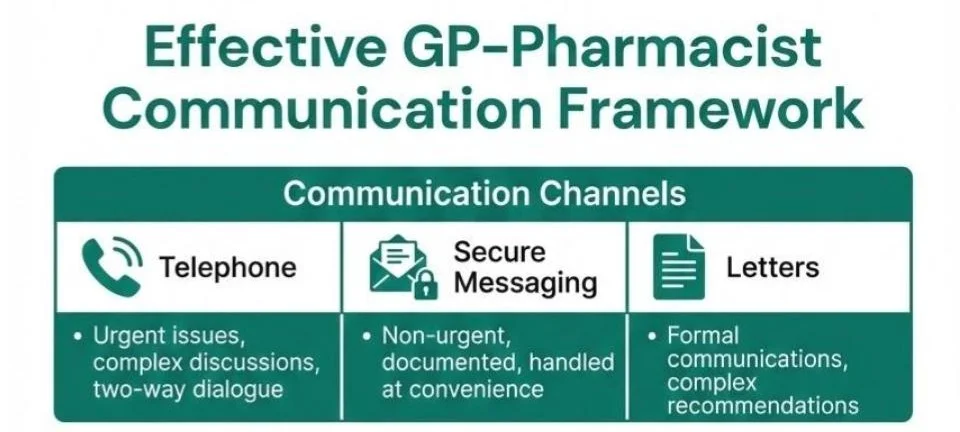
Communication Channels
Choosing the right technology platform for private prescribing services is a critical business decision that affects clinical workflow efficiency, regulatory compliance capability, patient experience, and long-term operational costs. The UK market offers several approaches including per-consultation fee platforms that charge for each prescription generated, marketplace models that aggregate patients across multiple practitioners, custom-built systems that require significant upfront development investment, and flat-rate subscription platforms that provide unlimited access to all features for a fixed monthly fee. Key evaluation criteria should include the comprehensiveness of the clinical workflow covering booking, consultation, prescribing, and follow-up in a single system, the quality of compliance features including audit trails, controlled drug management, and inspection-preparation reporting, integration capabilities with video consultation tools and payment processors, and the total cost of ownership calculated against realistic consultation volumes. Flat-rate platforms typically offer the best value for practitioners conducting more than fifteen consultations per month, as per-consultation charges accumulate quickly and can significantly erode consultation revenue at higher volumes.
Telephone
Best for urgent issues, complex discussions, and two-way dialogue. Challenges include getting through to prescribers, time constraints on both sides, and no written record without follow-up.
Secure Electronic Messaging
Best for non-urgent issues, documentation needs, and detailed information. Benefits include written record, can be handled when convenient, and clear documentation. Challenges include slower response and not suitable for urgent matters.
Letters and Faxes
Traditional but declining. Use for formal communications, complex recommendations, and documentation requirements.
Effective Intervention Communication
Before Communicating
Prepare by gathering all relevant patient information, researching the clinical issue thoroughly, knowing what outcome you want, and having evidence ready if needed.
Structure Your Message
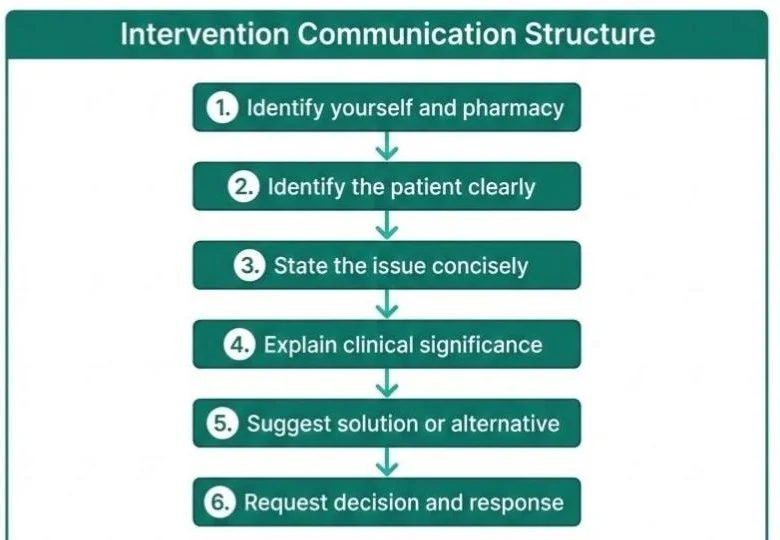
Use a clear structure: identify yourself and your pharmacy, identify the patient clearly, state the issue concisely, explain the clinical significance, suggest a solution or alternative, ask for decision and response.
Be Professional
Respect prescriber expertise. Present information objectively. Avoid accusatory language. Focus on patient benefit. Accept that prescriber may have information you do not.
Document Everything
Record the issue identified, who you contacted, what was discussed, the decision made, and any follow-up required.
Building Relationships
Proactive Engagement
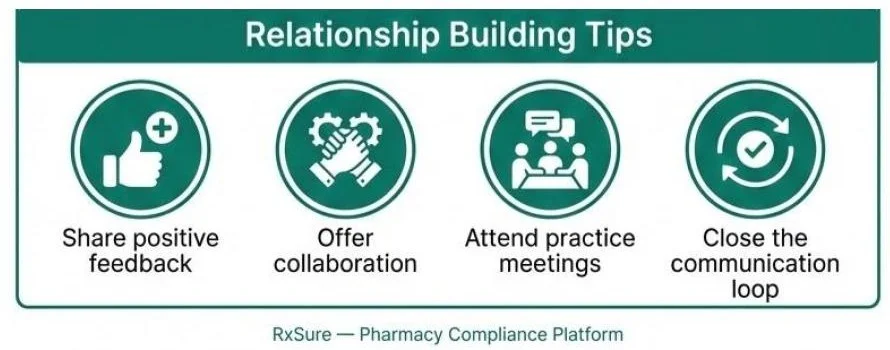
Do not only contact for problems. Share positive feedback when appropriate. Offer collaboration on patient care. Provide clinical service information. Attend practice meetings if invited.
Consistent Quality
Ensure every communication is professional, accurate, concise, solution-oriented, and timely.
Follow Up
Close the loop by confirming action taken, updating patient, documenting outcome, and thanking prescriber when appropriate.
Handling Difficult Conversations
When Prescriber Disagrees
Listen to their reasoning. They may have information you lack. If you still have concerns, document clearly. Escalate if patient safety at risk. Accept professional disagreement where reasonable.
When You Cannot Get Through
Try alternative routes. Leave clear messages. Document attempts. Use secure messaging as backup. Escalate urgent issues appropriately.
References
- General Pharmaceutical Council. Standards for Pharmacy Professionals. GPhC, 2024.
- National Institute for Health and Care Excellence. NICE Guidelines. NICE, 2024.
- British National Formulary. BNF Online. NICE, 2024.
- Information Commissioner’s Office. Guide to UK GDPR. ICO, 2024.
Technology Support
Modern systems can generate intervention documentation, provide clinical evidence, track communication history, and facilitate secure messaging.
RxSure documents interventions and communications as part of consultation workflows. Every interaction is recorded, creating audit trail and supporting continuity.
Start your free trial and improve GP communication.