

How RxSure Helps Pharmacies Earn More from Private Services
Community pharmacies across the UK are discovering that private services revenue can transform their business. While NHS contract income remains important, the pharmacies thriving in…
Community pharmacies across the UK are discovering that private services revenue can transform their business. While NHS contract income remains important, the pharmacies thriving in 2026 are those that have built strong private service offerings alongside their core dispensing activity.
This guide explores how private prescription software helps pharmacies access new revenue streams, increase patient loyalty, and build a sustainable business model beyond NHS funding.
The Private Services Revenue Opportunity
Building a sustainable revenue model for private prescribing services requires careful pricing strategy, service selection, and operational planning informed by local market demand and competition analysis. The most successful pharmacy-based private prescribing services start with two or three high-demand services, typically weight management and travel health, and expand their offering based on patient demand and prescriber competence development. Pricing should reflect the clinical value of the consultation, the cost of the prescriber’s time, and local market rates, while remaining accessible to the target patient population. Typical consultation fees in the UK range from twenty-five to sixty pounds depending on the service complexity and medication costs. Revenue projections should account for realistic patient volumes during the first six months of service launch, which are typically lower than steady-state volumes as awareness builds through marketing and word-of-mouth referrals. A digital platform with flat-rate pricing, such as RxSure at one hundred and ninety-nine pounds per month with zero per-consultation fees, ensures that the technology cost remains predictable regardless of consultation volume.
The UK private healthcare market has grown significantly, with patients increasingly willing to pay for convenience, speed, and access. Community pharmacies are uniquely positioned to capture this demand because they already have patient trust, clinical expertise, and high-street accessibility.
Revenue Potential by Service Type
| Service | Revenue Per Consultation | Monthly Potential (10 patients/week) |
|---|---|---|
| Weight Management (GLP-1) | £150–£300/month | £6,000–£12,000 |
| Travel Health Consultations | £30–£80 | £1,200–£3,200 |
| Sexual Health Services | £25–£60 | £1,000–£2,400 |
| Dermatology Treatments | £40–£90 | £1,600–£3,600 |
| Ear Wax Removal | £40–£70 | £1,600–£2,800 |
| Hair Loss Treatment | £30–£60/month | £1,200–£2,400 |
A pharmacy offering just 3–4 of these services can realistically generate £5,000–£15,000 in additional monthly revenue, without any increase in NHS contract work.
Why Technology Is the Key Differentiator
Marketing private prescribing services effectively requires a combination of digital presence, local community engagement, and referral network development to build patient awareness and trust. The most effective marketing channels for pharmacy-based private services include a professional website with online booking capability, local search engine optimisation targeting service-specific keywords such as weight management consultation or travel vaccinations near me, Google Business Profile optimisation with service descriptions and patient reviews, social media content demonstrating clinical expertise and patient outcomes, and in-pharmacy promotional materials including window displays and consultation room signage. Building referral relationships with local GP practices is particularly valuable because GPs who are aware of your private prescribing services may direct patients to you for treatments they cannot provide through NHS pathways, such as GLP-1 weight management or private travel vaccinations. Patient reviews and testimonials, collected with appropriate consent and displayed on your website and Google profile, provide social proof that encourages new patients to book. Digital platforms with branded booking pages and patient portals support marketing efforts by providing a professional online presence.
The pharmacies generating the highest private revenue are not simply offering more services, they are using technology to make those services scalable, compliant, and patient-friendly. Here is why software matters:
1. Online Booking Removes Barriers
When patients can book online 24/7, you capture demand that would otherwise go to a competitor. Walk-in services are limited by opening hours and staff availability. Online booking fills your diary around the clock.
2. Structured Consultations Improve Outcomes
Template-driven consultations ensure every patient receives a consistent, clinically appropriate service. This improves patient outcomes, supports compliance, and makes it easier to train new team members.
3. Electronic Prescriptions Save Time
E-prescribing software reduces prescription generation from 3–5 minutes to under 60 seconds. At 10 prescriptions per day, that saves over 10 hours per month, time that can be spent seeing more patients.
4. Integrated Payments Reduce Admin
When payment is collected at the point of consultation, you eliminate invoicing, chasing payments, and revenue leakage. Patients pay via card or contactless, and the transaction is automatically recorded.
5. Compliance Dashboards Protect Your Registration
Private services carry regulatory obligations. Software with built-in compliance tracking ensures you maintain proper GPhC compliance records, audit trails, and documentation without manual effort.
Building a Private Services Menu
The most successful pharmacies take a strategic approach to service selection. Rather than trying to offer everything at once, they build progressively:
Phase 1: Quick Wins (Month 1–2)
- Sexual health, high demand, straightforward consultations, PGD-eligible
- Hair loss treatment, recurring revenue, simple follow-ups
- Smoking cessation, established demand, pharmacy-friendly
Phase 2: Growth Services (Month 3–6)
- Weight management, highest revenue per patient, requires IP qualification or PGD
- Travel health, seasonal peaks, good margins
- Dermatology, growing demand, recurring prescriptions
Phase 3: Specialist Services (Month 6+)
- Ear wax removal, requires equipment investment, high margins
- Vitamin B12 injections, recurring revenue, simple delivery
- Blood testing services, partnerships with diagnostic labs
How RxSure Powers Private Service Revenue
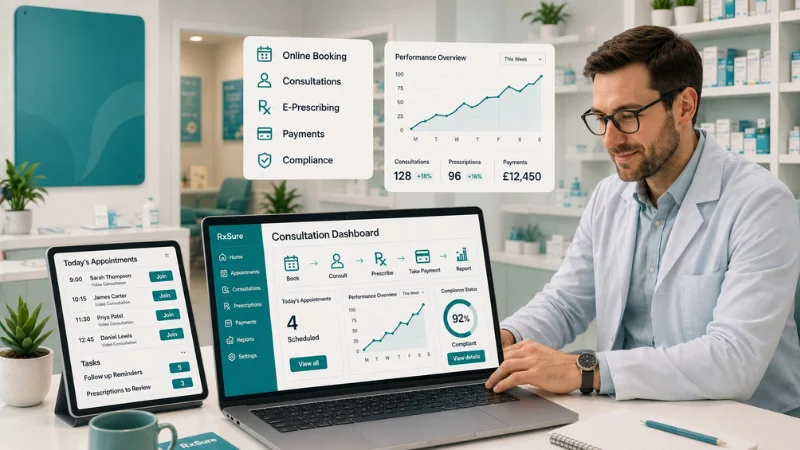
RxSure provides the complete technology stack pharmacies need to deliver private services professionally and profitably:
- Online booking portal, patients book and pay in advance, reducing no-shows
- Consultation templates, service-specific templates ensure clinical quality and compliance
- Electronic prescribing, generate prescriptions in seconds with built-in safety checks
- Payment integration, collect fees at point of service, automated receipts
- Patient records, complete clinical records with audit trail for GPhC
- Compliance dashboard, real-time visibility of your compliance status
- Multi-service support, manage unlimited service types from one platform

Unlike piecing together separate booking, prescribing, and payment tools, RxSure provides a single integrated platform, one login, one patient record, one audit trail.
Calculating Your Revenue Potential
Here is a simple calculation for estimating your private services revenue:
- Identify 3 services you can offer based on your qualifications and local demand
- Estimate consultations per week, start conservatively (5–10 per service)
- Multiply by average fee, use the table above for guidance
- Subtract platform costs, RxSure costs from £49/month with no setup fees
- Factor in time savings, faster consultations mean more patients per hour
Most pharmacies find that even a modest private services operation covers the software cost within the first week and generates meaningful profit from month one.
Common Mistakes to Avoid
- Launching too many services at once, start with 2–3 and perfect the workflow before expanding
- Not marketing services, patients will not know you offer private services unless you tell them
- Underpricing, research competitor pricing and price for value, not just cost recovery
- Ignoring compliance, GPhC inspection preparation must be built in from day one
- Using disconnected tools, separate booking, prescribing, and payment systems create gaps and inefficiency
References
- General Pharmaceutical Council. Standards for Pharmacy Professionals. GPhC, 2024.
- National Institute for Health and Care Excellence. NICE Guidelines. NICE, 2024.
- British National Formulary. BNF Online. NICE, 2024.
- Information Commissioner’s Office. Guide to UK GDPR. ICO, 2024.
Key Takeaways
- Private services can generate £5,000–£15,000+ additional monthly revenue for community pharmacies
- Technology is the differentiator, integrated software makes services scalable and compliant
- Start with 2–3 high-demand services and expand progressively
- Online booking, e-prescribing, and integrated payments are essential for efficiency
- RxSure provides the complete platform for private service delivery from one system
Ready to grow your pharmacy’s private services revenue? Start your free 3-month trial of RxSure, no setup fees, no commitment.