
TL;DR: Listing on third-party pharmacy marketplaces means handing over your patient relationships, your data, your branding, and a slice of every transaction. Owning your own online prescribing platform keeps patients connected to your brand and builds long-term business value.
TL;DR
Listing on third-party pharmacy marketplaces means handing over your patient relationships, your data, your branding, and a slice of every transaction. Owning your own online prescribing platform — whether white-labelled or built on a tool like RxSure — keeps patients connected to your brand, gives you full control over pricing and data, and builds long-term business value. At £199/mo with no commission, RxSure lets you launch your own branded online prescribing service in under an hour.
Here is a scenario that plays out daily across UK pharmacy: a patient walks in, asks about a private service — weight management, sexual health, travel clinic — and the pharmacist directs them to a third-party online platform. The patient books, consults, pays, and gets their prescription. Everyone is happy.
Except the pharmacist just sent that patient to someone else’s business. The patient’s data now belongs to the marketplace. The patient associates their positive experience with the platform brand, not with the pharmacist who recommended it. And when the patient needs a repeat consultation, they go back to the marketplace — not to the pharmacy.
This pattern repeats across thousands of pharmacies. Prescribers invest in qualifications, clinical skills, and patient relationships, then funnel all of that value through platforms that capture it for themselves. There is a better way: owning your online platform.
The Marketplace Model: What You’re Really Signing Up For
Third-party pharmacy marketplaces offer an appealing proposition: instant access to a patient base, handled technology, and minimal setup effort. You list your services, patients find you, and the platform handles booking and payment. In exchange, the marketplace takes a commission on each transaction — typically 15–30% of the consultation fee.
But the trade-offs run deeper than the commission percentage.
The Platform Owns the Patient Relationship
When a patient books through a marketplace, they create an account on that platform. Their medical history, consultation notes, and contact details are stored in the marketplace’s system. If you leave the platform, those patient records do not come with you. The platform can also market to your patients — including promoting competing pharmacies.
Your Brand Disappears
Marketplace pages follow a standardised template. Your pharmacy is one listing among hundreds. Patients see the marketplace’s logo, the marketplace’s branding, and the marketplace’s user experience. Your pharmacy name appears in small text. The patient remembers the platform, not you.
You Cannot Control Pricing
Many marketplaces set price floors, caps, or recommended pricing. Some dictate that you cannot charge above a certain threshold to maintain “platform consistency.” Your commercial freedom is constrained by policies designed to benefit the marketplace, not your business.
The Rules Can Change Overnight
Marketplaces can increase their commission, change their terms, modify their algorithms to favour other providers, or shut down entirely. You have no recourse. Your entire online revenue channel depends on a third party whose interests may not align with yours.
The Own-Platform Model: Taking Back Control
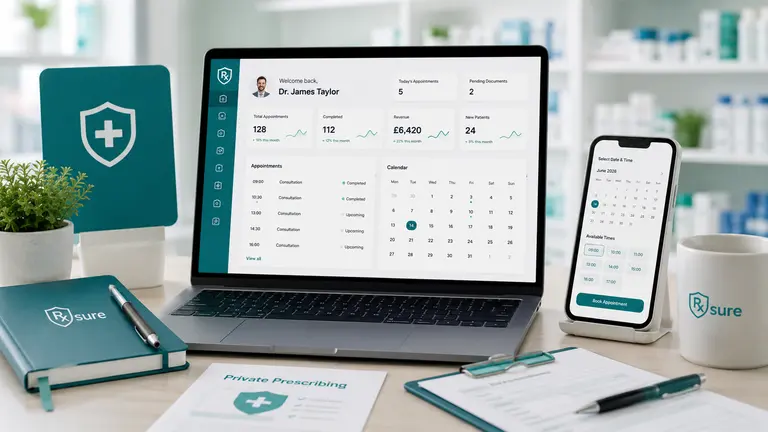
Running your own online prescribing platform means patients interact with your brand from start to finish. You control the booking process, the consultation experience, the follow-up communications, and the data.
Your branding throughout: Patients see your pharmacy name, your logo, your messaging. Every touchpoint reinforces your professional identity. When they tell friends about the service, they recommend you — not a faceless marketplace.
Full data ownership: Patient records, consultation history, and contact information belong to you. You can use this data to send follow-up reminders, manage ongoing care, and build meaningful clinical relationships — all in full compliance with UK GDPR and GPhC requirements [1].
Complete pricing control: You set your fees based on your costs, your market, and your clinical judgement. No platform caps, no mandatory discounts, no commission on patient payments.
Service flexibility: Add or remove clinical services as your scope of practice and business needs evolve. A marketplace may restrict which services you can offer; your own platform gives you complete flexibility to launch a full range of private prescribing services on your terms.
Head-to-Head Comparison
| Factor | Third-Party Marketplace | Your Own Platform (e.g. RxSure) |
|---|---|---|
| Brand visibility | Minimal — your pharmacy is one of many listings | Full — your brand on every patient touchpoint |
| Patient data ownership | Platform owns or co-owns the data | You own 100% of patient data |
| Pricing control | Restricted by platform rules or caps | Complete freedom to set your own fees |
| Fee structure | 15–30% commission per transaction | Flat £199/mo — no commission, no hidden fees |
| Patient loyalty | Patients loyal to marketplace, not your pharmacy | Patients loyal to your brand — direct rebooking |
| Marketing flexibility | Limited to platform’s marketing tools | Full control — email, social, local marketing |
| Multi-service capability | Restricted to services the marketplace supports | Add any service within your scope of practice |
| Regulatory control | Shared responsibility; platform may not meet your standards | Full oversight of compliance and clinical governance |
The Long-Term Revenue Impact
The financial difference between the two models compounds over time. Consider a prescriber generating £3,000 per month in consultation fees.
On a marketplace (20% commission): £600/mo goes to the platform. That is £7,200 per year in commission payments — and this grows as your revenue grows. At £5,000/mo revenue, the marketplace takes £12,000 per year.
On your own platform (RxSure): £199/mo flat. At £3,000/mo revenue, your platform cost is 6.6% of turnover. At £5,000/mo, it drops to 4%. The percentage shrinks as your business grows, which is the opposite of a commission model.
But the revenue impact extends beyond direct fees. When patients book through your brand, they are more likely to:
- Return for repeat prescriptions — they know where to find you
- Use additional services — they trust your pharmacy, not just one specific service
- Refer friends and family — word-of-mouth marketing mentions your pharmacy name, not a marketplace URL
- Purchase other pharmacy products — cross-selling opportunities for OTC products, health checks, and dispensing services
Patient lifetime value is dramatically higher when patients are loyal to your brand rather than a platform. Research consistently shows that acquiring a new patient costs 5–7 times more than retaining an existing one [2]. Owning the patient relationship is not just about today’s consultation fee — it is about building a patient base that generates revenue for years.
Common Objections — and the Reality
“Marketplaces bring traffic — I can’t generate my own”
True, marketplaces aggregate demand. But at what cost? You are paying 15–30% of every consultation for that traffic. Instead, invest a fraction of those commission savings into local marketing, Google Business Profile optimisation, and social media. A well-optimised Google Business Profile can drive significant local traffic at zero ongoing cost [3]. Your existing walk-in patients are already a ready-made audience — simply tell them about your new online service.
“Building a platform is expensive and complicated”
Building a bespoke platform from scratch? Yes, that would cost thousands. But solutions like RxSure provide the complete infrastructure — booking, consultations, prescribing, payment — for £199/mo. There is no development cost, no maintenance burden, and no technical expertise required. You can start your free trial and be live within an hour.
“I don’t have time for marketing”
You do not need to become a marketing agency. The platform handles the operational complexity — booking, scheduling, payments, prescription generation. Your marketing effort can be as simple as: adding your service to your pharmacy website, posting on social media, putting up in-pharmacy signage, and mentioning it during patient consultations. The patients are already in your pharmacy; you just need to let them know you offer private prescribing online.
“What if I don’t get enough patients initially?”
With a flat-rate model, low patient volume in the early months does not trigger escalating per-consultation costs. You pay the same £199 whether you see 5 patients or 50. This gives you breathing room to build your patient base without the pressure of variable costs. Use the early period to refine your service offering, gather patient reviews, and establish your online presence.
How to Transition from Marketplace to Your Own Platform
Switching does not need to be abrupt. A phased approach minimises risk and ensures continuity of care for existing patients.
Step 1: Set Up Your Platform
Create your RxSure account, configure your services, set your pricing, and familiarise yourself with the workflow. This takes approximately one hour. Explore the full feature set to understand what is available.
Step 2: Run Both Platforms in Parallel
Continue accepting bookings through the marketplace while directing new patients to your own platform. This lets you compare the experience and build confidence without losing existing patient flow.
Step 3: Redirect Existing Patients
When existing marketplace patients book follow-up appointments, let them know you now offer direct booking through your own service. Most patients will follow their prescriber — they chose you for your clinical expertise, not for the marketplace’s booking interface.
Step 4: Update Your Marketing
Update your pharmacy website, Google Business Profile, social media accounts, and in-pharmacy signage to point to your own platform. Remove or reduce your marketplace listing once patient flow has shifted.
Step 5: Monitor and Optimise
Track bookings, patient retention, and revenue per patient. You will likely find that patient retention improves when patients interact directly with your brand rather than through a marketplace intermediary.
Stop Sending Patients to Someone Else’s Platform
Launch your own branded prescribing service in under an hour. Free trial, £199/mo flat fee, zero commission.
Frequently Asked Questions
Can I use RxSure alongside a marketplace?
Yes. Many prescribers start by running both in parallel, gradually shifting patients to their own platform as they build confidence and direct patient flow. There is no exclusivity requirement with RxSure.
Do I need technical skills to set up my own platform?
No. RxSure is designed for clinicians, not developers. The setup process guides you through configuring your services, setting your pricing, and going live. Most prescribers are operational within an hour, with no coding or technical configuration required.
What happens to my patient data if I leave the marketplace?
This depends on the marketplace’s terms of service. Many platforms retain patient data even after you leave, as they consider it their data, not yours. Some allow data export; others do not. The GPhC expects pharmacists to maintain appropriate clinical records [4], so ensure you have independent records of all consultations regardless of which platform you use.
How does owning my platform affect GPhC compliance?
Owning your platform gives you greater control over compliance. You determine your clinical governance framework, your standard operating procedures, and your quality assurance processes. The GPhC’s guidance on providing pharmacy services at a distance [1] applies equally whether you use a marketplace or your own platform — but with your own platform, you have direct oversight of every aspect of the patient journey.
Is £199/mo cost-effective compared to a free marketplace listing?
“Free” marketplace listings are rarely free — they charge commission on every transaction. A prescriber earning £2,000/mo in consultation fees pays £400–£600/mo in marketplace commission (at 20–30%). RxSure’s flat £199/mo is more cost-effective from approximately 15–20 consultations per month onwards, and the gap widens significantly as volume increases. See our pricing page for details.
References
- General Pharmaceutical Council. Guidance for registered pharmacies providing pharmacy services at a distance, including on the internet. Available at: www.pharmacyregulation.org/guidance-registered-pharmacies-providing-pharmacy-services-distance-including-internet
- Bain & Company. The Value of Customer Loyalty. Research on customer retention economics. Available at: www.bain.com/insights/retaining-customers-is-the-real-challenge/
- Google. Google Business Profile Help — Get started. Available at: support.google.com/business/answer/6300717
- General Pharmaceutical Council. Standards for pharmacy professionals. Standard 4: Maintain, develop and use their professional knowledge and skills. Available at: www.pharmacyregulation.org/standards/standards-for-pharmacy-professionals
- General Pharmaceutical Council. Buying Medicines Safely Online. Available at: pharmacyregulation.org
About this article: This article was prepared by the RxSure editorial team and is informed by publicly available UK healthcare guidance. Source references include GPhC, NICE, and BNF where cited. Content is reviewed periodically to reflect current information. This article is for general informational purposes and should not be relied upon as professional, medical, or regulatory advice. Last updated: 14 June 2026.