

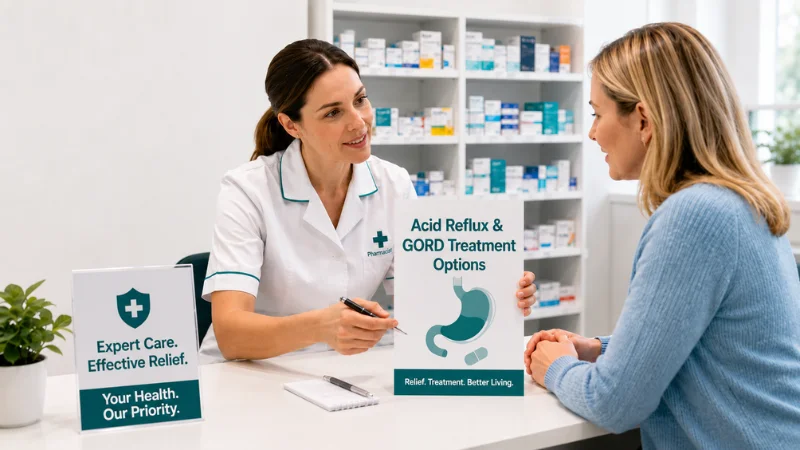
TL;DR: Get a private prescription for persistent acid reflux or GORD from a pharmacist prescriber. Clinical assessment and prescription-strength treatment without GP wait.
Understanding Acid Reflux and GORD
Private prescribing in the United Kingdom enables pharmacist independent prescribers, GPs, nurses, and other qualified healthcare professionals to issue prescriptions for medications outside the NHS, covering services such as weight management, travel health, sexual health, dermatology, hair loss treatment, and aesthetic procedures. The legal framework for private prescribing requires practitioners to hold an appropriate prescribing qualification registered with their professional body, maintain professional indemnity insurance that covers their prescribing activities, work within a defined formulary that reflects their clinical competence, and comply with the regulatory standards set by the GPhC for pharmacy-based prescribers or the CQC for clinic-based services. Private prescriptions must include the prescriber’s name, qualification, and registration number, the date of prescribing, the patient’s name and address, and the medication details including drug name, formulation, dosage, quantity, and directions for use. Digital prescribing platforms automate the formatting and content requirements for private prescriptions, reducing errors and ensuring regulatory compliance.
Acid reflux is one of the most common digestive complaints in the United Kingdom, affecting millions of people on a regular basis. It occurs when stomach acid flows back up into the oesophagus, causing the characteristic burning sensation known as heartburn. When this happens frequently, typically two or more times per week, it is classified as gastro-oesophageal reflux disease, commonly abbreviated to GORD.
The lower oesophageal sphincter, a ring of muscle at the junction between the oesophagus and the stomach, normally acts as a one-way valve. In people with GORD, this sphincter relaxes at inappropriate times or becomes weakened, allowing acidic stomach contents to travel upwards. Over time, this repeated exposure to acid can cause inflammation, erosion, and even structural changes to the oesophageal lining.
The impact on daily life can be substantial. Persistent heartburn disrupts sleep, makes eating unpleasant, and can cause anxiety about mealtimes. Some patients develop a chronic cough, hoarse voice, or a sensation of a lump in the throat, symptoms that are not always immediately associated with reflux. Left unmanaged, chronic GORD can lead to complications such as oesophagitis, Barrett’s oesophagus, and in rare cases, oesophageal strictures.
When Over-the-Counter Antacids Are Not Sufficient
Starting a private prescribing practice involves several practical steps that can be completed within one to four weeks depending on the practitioner’s existing infrastructure and the services they plan to offer. The first step is ensuring that the prescriber’s independent prescribing qualification is annotated on their professional register and that their professional indemnity insurance explicitly covers private prescribing activities. Next, the practitioner should define their clinical scope by establishing a formulary of medications they are competent to prescribe, based on their training, experience, and ongoing continuing professional development. Standard operating procedures must be developed for each service covering patient assessment criteria, prescribing protocols, safety netting advice, and referral pathways. A consultation room meeting GPhC or CQC standards for private consultations must be available, whether within an existing pharmacy, clinic, or dedicated practice space. Finally, selecting a digital prescribing platform that provides online booking, guided consultations, prescription generation, and compliance documentation enables the practitioner to begin accepting patients within hours of completing setup and configuration.
Many people begin managing acid reflux with over-the-counter remedies such as antacids, alginate preparations, or low-dose acid suppressants. These products are effective for occasional, mild symptoms and provide short-term relief by neutralising stomach acid or forming a protective barrier.
However, there comes a point for many patients where these treatments are no longer adequate. Signs that you may need prescription-strength treatment include:
- Symptoms persisting despite regular antacid use, taking antacids daily for more than two weeks suggests an underlying condition requiring stronger treatment
- Night-time reflux disrupting sleep, waking with heartburn, coughing, or a sour taste indicates poorly controlled acid production
- Regurgitation of food or acid, this suggests more significant sphincter dysfunction requiring medical assessment
- Symptoms affecting diet and weight, avoiding foods or eating less due to fear of symptoms impacts nutrition and quality of life
- Chest pain or difficulty swallowing, these symptoms always warrant clinical assessment to exclude serious conditions
If you recognise these patterns, a private consultation with a pharmacist independent prescriber can provide timely access to effective treatment without the wait for a GP appointment.
Prescription Medicines: PPIs and H2 Receptor Antagonists
Proton pump inhibitors (PPIs) are the mainstay of prescription treatment for GORD. They work by irreversibly blocking the hydrogen-potassium ATPase enzyme system, the proton pump, in the stomach lining, dramatically reducing acid production at its source.
Commonly Prescribed PPIs
- Omeprazole, the most widely prescribed PPI, typically started at 20mg once daily, taken before breakfast. Available in capsule form and well tolerated by most patients.
- Lansoprazole, an alternative PPI at 15-30mg daily, often preferred for patients who do not respond optimally to omeprazole or experience side effects.
- Esomeprazole, the S-isomer of omeprazole, sometimes used where enhanced acid suppression is needed, at 20-40mg daily.
PPIs are typically prescribed for an initial course of four to eight weeks, after which symptoms are reviewed. Many patients achieve excellent symptom control and can step down to a lower dose or use treatment on an as-needed basis.
H2 Receptor Antagonists
Where PPIs are not suitable or as an adjunct to treatment, H2 receptor antagonists such as famotidine may be prescribed. These medicines reduce acid production by a different mechanism, blocking histamine receptors on the parietal cells. They are particularly useful for patients with predominantly night-time symptoms when taken before bed.
Clinical Assessment and Red Flag Symptoms
A thorough clinical assessment is essential before prescribing for acid reflux or GORD. Your pharmacist independent prescriber will take a detailed history covering the nature, frequency, and duration of your symptoms, along with any treatments you have already tried.
Critically, the assessment includes screening for red flag symptoms that require urgent medical referral rather than private prescribing. These include:
- Dysphagia, difficulty swallowing, particularly if progressive, may indicate an oesophageal stricture or malignancy
- Unexplained weight loss, unintentional weight loss alongside reflux symptoms warrants urgent investigation
- Haematemesis, vomiting blood or material resembling coffee grounds requires immediate medical attention
- Melaena, dark, tarry stools suggesting gastrointestinal bleeding
- Persistent vomiting, recurrent vomiting alongside reflux may indicate gastric outlet obstruction
- Iron deficiency anaemia, unexplained anaemia may suggest chronic bleeding from oesophageal erosion
The three possible outcomes of your consultation are: prescribe appropriate treatment, advise on self-management strategies, or refer to a GP or specialist for further investigation. This ensures your safety is always the priority.
Lifestyle Advice Alongside Prescribing
Medication alone is rarely the complete answer. Your pharmacist prescriber will discuss lifestyle modifications that can significantly improve GORD symptoms alongside prescription treatment:
- Dietary triggers, common triggers include spicy food, citrus fruits, tomatoes, chocolate, caffeine, alcohol, and fatty or fried foods. Identifying and reducing your personal triggers is key.
- Meal timing and portion size, eating smaller meals and avoiding food within three hours of bedtime reduces reflux episodes significantly.
- Weight management, excess abdominal weight increases intra-abdominal pressure, worsening reflux. Even modest weight loss can improve symptoms.
- Sleeping position, elevating the head of the bed by 15-20cm (using bed blocks, not extra pillows) reduces nocturnal acid exposure.
- Smoking cessation, smoking relaxes the lower oesophageal sphincter and increases acid production, making it a significant contributor to GORD.
- Clothing, avoiding tight belts and waistbands that increase abdominal pressure can provide simple but effective relief.
Sources & References
- General Pharmaceutical Council. Standards for Pharmacy Professionals. GPhC, 2024.
- National Institute for Health and Care Excellence. NICE Guidelines. NICE, 2024.
- British National Formulary. BNF Online. NICE, 2024.
- Information Commissioner’s Office. Guide to UK GDPR. ICO, 2024.
How to Book an Acid Reflux Consultation
If persistent acid reflux or GORD is affecting your quality of life, you can access a private consultation with a pharmacist independent prescriber through RxSure. The process is straightforward and designed for convenience.
Simply book through the RxSure patient portal, selecting an acid reflux or gastrointestinal consultation. Before your appointment, it is helpful to note how long you have experienced symptoms, what treatments you have tried, and any other medications you are currently taking.
Your pharmacist prescriber will conduct a thorough clinical assessment and, where appropriate, provide a private prescription for effective treatment. Follow-up appointments can be arranged to review your progress and adjust treatment as needed.
Do not let acid reflux control your life. Professional assessment and prescription-strength treatment are available without the wait. Learn more about how private prescriptions work in the UK or read about clinical criteria and compliance in pharmacy prescribing.
About this article: This article was prepared by the RxSure editorial team and is informed by publicly available UK healthcare guidance. Source references include GPhC, NICE, and BNF where cited. Content is reviewed periodically to reflect current information. This article is for general informational purposes and should not be relied upon as professional, medical, or regulatory advice. Last updated: 26 July 2026.