

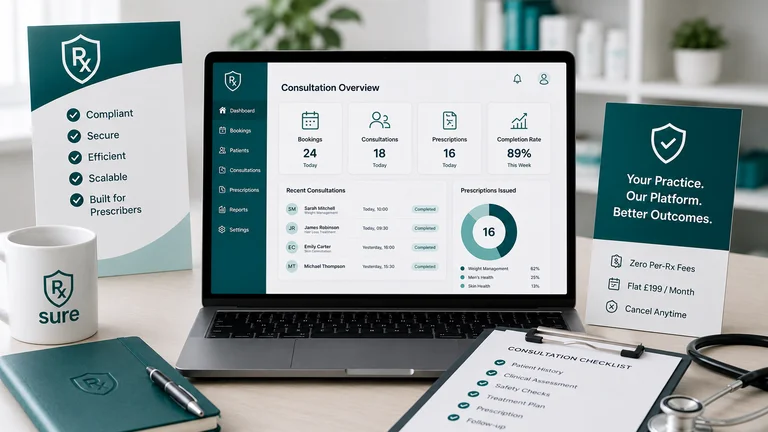
TL;DR: Private prescribing software should handle patient booking, clinical questionnaires, consultation notes, prescription generation, and audit trails. Avoid platforms with per-prescription fees, long lock-in contracts, or missing compliance features. This guide gives you the evaluation framework to choose with confidence.
Choosing prescribing software is one of the most consequential decisions a private prescriber makes. The wrong platform creates friction in every consultation, introduces compliance gaps, and bleeds money through hidden fees. The right one becomes invisible — it supports your clinical workflow without getting in the way.
This guide provides a structured evaluation framework based on regulatory requirements, clinical workflow needs, and financial sustainability. Whether you are a pharmacist independent prescriber, a GP branching into private work, or a nurse prescriber launching a specialist clinic, the fundamentals are the same.
The Non-Negotiable Requirements
Before comparing features or pricing, any platform you consider must meet these baseline requirements. Absence of any one of these is a disqualifier:
1. Regulatory Compliance
- UK GDPR compliance — health data is “special category” data under Article 9. The platform must process and store data in the UK or adequate jurisdiction, with a documented Data Processing Agreement (DPA).
- Prescription format compliance — private prescriptions must meet requirements under the Human Medicines Regulations 2012 (regulation 217). The platform must generate prescriptions with all mandatory fields.
- Audit trail — the GPhC Standards for Registered Pharmacies (Standard 4) and GMC Good Medical Practice both require adequate clinical records. Every interaction must be timestamped and attributable.
- Data security — encryption at rest and in transit, role-based access control, regular penetration testing, and ISO 27001 certification or equivalent.
2. Clinical Workflow Support
- Structured consultations — the platform should guide the consultation from history-taking through assessment to prescribing decision, capturing the clinical rationale at each stage.
- Pre-screening — condition-specific questionnaires that filter out clinically inappropriate patients before they reach a prescriber.
- Safety alerts — drug interaction warnings, allergy checks, contraindication flags based on the patient’s recorded history.
- Referral pathways — clear, documented escalation when a patient needs onward referral rather than prescribing.
3. Patient Experience
- Self-service booking — patients should book, complete questionnaires, and provide history before the consultation slot. This respects both their time and yours.
- Mobile-responsive interface — the majority of patients will access services from smartphones. A platform that only works well on desktop is a conversion killer.
- Clear communication — automated confirmations, reminders, and follow-up messaging that keep patients informed without manual effort from your team.
The Pricing Trap: Per-Prescription vs Flat Rate
Platform pricing models fall into three categories, and the differences compound significantly over time:
| Model | How It Works | Cost at 50 Rx/month | Cost at 200 Rx/month |
|---|---|---|---|
| Per-prescription (£3-5/Rx) | Pay per prescription issued | £150–£250 | £600–£1,000 |
| Tiered subscription | Monthly fee with volume caps | £200–£400 | £500–£800 |
| Flat rate (RxSure) | Fixed monthly fee, unlimited use | £199 | £199 |
The maths are clear: per-prescription models punish success. As your practice grows and you issue more prescriptions, your platform costs grow linearly. A flat-rate model like RxSure’s £199/month means your margin improves with every additional patient — the platform cost becomes a smaller percentage of revenue as you scale.
Over 12 months, a prescriber issuing 150 prescriptions per month would pay approximately £5,400–£9,000 on a per-prescription model versus £2,388 on a flat rate. That difference — £3,000–£6,600 per year — goes directly to your bottom line.
Feature Comparison: What to Ask During Demos
When evaluating platforms, ask these specific questions. Vague answers or “coming soon” responses are red flags:
- Where is patient data stored? — Acceptable answer: named UK data centre with specific certifications. Unacceptable: “the cloud” without specifics.
- Can I export my patient records? — You must be able to leave without losing data. Vendor lock-in through data hostage-taking is unacceptable.
- What happens if the platform goes down? — Ask about SLA, uptime history, and the disaster recovery plan.
- How are prescriptions stored and retrievable? — You need access to historical prescriptions for audit purposes, potentially years after issuance.
- What integrations are available? — Payment processing, video consultation, SMS notifications, GP notification letters.
- What support is included? — Response times, channels (phone/email/chat), hours of availability.
- Is there a minimum contract term? — Monthly rolling contracts give you flexibility. 12-month lock-ins are a gamble.
Implementation: What “Go Live” Actually Looks Like
The implementation timeline is a meaningful differentiator between platforms. Some require weeks of setup, training, and configuration. Others are designed for rapid deployment:
- Same-day platforms — account creation, basic configuration, and first patient booking within hours. RxSure is designed for this: most prescribers are live within 60 minutes.
- Week-one platforms — require initial training sessions, custom form building, and integration setup. Typical of mid-market solutions.
- Month-one platforms — enterprise systems with complex onboarding, data migration, staff training programmes, and iterative configuration. Appropriate for large organisations, overkill for individual prescribers or small teams.
Match the implementation complexity to your actual needs. A solo prescriber does not need enterprise onboarding — they need to see patients.
Clinical Governance Integration
Your prescribing platform should actively support clinical governance, not merely record it passively. Look for:
- Prescribing audit reports — automated analysis of prescribing patterns, volumes, and outcomes
- Formulary enforcement — the platform should restrict prescribing to your defined scope, preventing accidental prescribing outside competence
- Peer review support — ability to share anonymised cases for clinical discussion and learning
- CPD evidence generation — prescribing data that feeds into your professional development portfolio for GPhC or GMC revalidation
Frequently Asked Questions
Should I choose a platform specific to my profession?
Not necessarily. The prescribing workflow is fundamentally similar whether you are a pharmacist, GP, or nurse independent prescriber. What matters is whether the platform can accommodate your specific clinical workflows and consultation types. A good platform serves all prescriber types with configurable templates rather than profession-locked features.
What if I want to change platforms later?
Data portability is key. Before committing, confirm you can export patient records, consultation notes, and prescription history in a standard format. Under UK GDPR, patients also have the right to data portability (Article 20) — your platform must support this. Avoid platforms that make migration difficult through proprietary data formats.
Do I need separate software for video consultations?
Ideally not. An integrated platform that includes video consultation capability within the clinical workflow is more efficient and creates a better audit trail than switching between separate tools. However, some prescribers prefer specialist video platforms (like Whereby or Zoom for Healthcare) integrated via API — check whether your chosen platform supports this.
Is a free platform ever worth it?
Free platforms typically monetise through advertising, data sharing, or extreme feature limitations. For clinical services handling sensitive patient data, “free” usually means you are the product. Invest in a platform that aligns its revenue model with your interests — you paying a fair subscription means the platform’s incentives align with keeping you successful.
How do I evaluate platforms without committing?
Request a free trial (not just a demo) where you can test the actual platform with realistic scenarios. Create test patients, run through consultation workflows, generate prescriptions, and test the patient-facing booking experience. RxSure’s free trial gives full platform access so you can evaluate thoroughly before committing.
References
- Human Medicines Regulations 2012. Regulation 217: Requirements for private prescriptions. legislation.gov.uk
- Information Commissioner’s Office. Guide to the UK General Data Protection Regulation. ico.org.uk
- General Pharmaceutical Council. Standards for Registered Pharmacies. Standard 4: Services. pharmacyregulation.org
- General Medical Council. Good Medical Practice. Domain 1: Knowledge, Skills, and Performance. gmc-uk.org
Try Before You Commit
Full platform access. No credit card. No per-prescription fees. See why prescribers choose RxSure’s flat £199/month model.
About this article: This article was prepared by the RxSure editorial team and is informed by publicly available UK healthcare guidance. Source references include GPhC, NICE, and BNF where cited. Content is reviewed periodically to reflect current information. This article is for general informational purposes and should not be relied upon as professional, medical, or regulatory advice. Last updated: 7 June 2026.