

TL;DR: A practical digital compliance checklist for passing your GPhC inspection. Covers SOPs, consultation records, staff records, clinical governance, patient safety, and data protection — with tips on how digital tools make inspections easier.
A GPhC inspection can feel daunting, especially if your pharmacy has recently started offering private prescribing services. But with the right preparation, inspections become straightforward. This guide provides a practical, step-by-step digital compliance checklist that ensures your pharmacy is inspection-preparation at all times, not just when you know an inspector is coming.
What Happens During a GPhC Inspection?
GPhC compliance is a fundamental requirement for every pharmacy providing private prescribing services in the United Kingdom, and digital platforms have become the most effective way to maintain and demonstrate compliance during inspections. The General Pharmaceutical Council evaluates pharmacies against its Standards for Registered Pharmacies, which cover governance, staff competence, premises suitability, service delivery, and patient safety. For private prescribing services, inspectors specifically examine whether consultation records are complete and contemporaneous, whether prescribing decisions are clinically justified and documented, whether standard operating procedures are current and accessible, whether controlled drug registers are accurately maintained, and whether patient complaints are recorded and acted upon. Digital compliance management platforms provide significant advantages over paper-based systems because they create automatic, timestamped audit trails for every clinical action, prevent records from being altered retrospectively, enforce mandatory documentation steps within consultation workflows, and generate inspection-preparation reports that demonstrate ongoing compliance. Pharmacies using structured digital platforms typically report smoother GPhC inspections with fewer follow-up actions required.
GPhC inspections assess whether your pharmacy meets the Standards for Registered Pharmacies. Inspectors typically:
- Arrive with or without advance notice (both announced and unannounced inspections happen)
- Spend 2-6 hours reviewing your premises, records, and processes
- Interview the superintendent pharmacist, responsible pharmacist, and support staff
- Review documentation including SOPs, training records, and consultation notes
- Observe live workflows where possible
- Produce a written report with findings and any required actions
For pharmacies offering private services, inspectors pay particular attention to private prescribing records, clinical governance, and patient safety processes.
The Digital Compliance Checklist
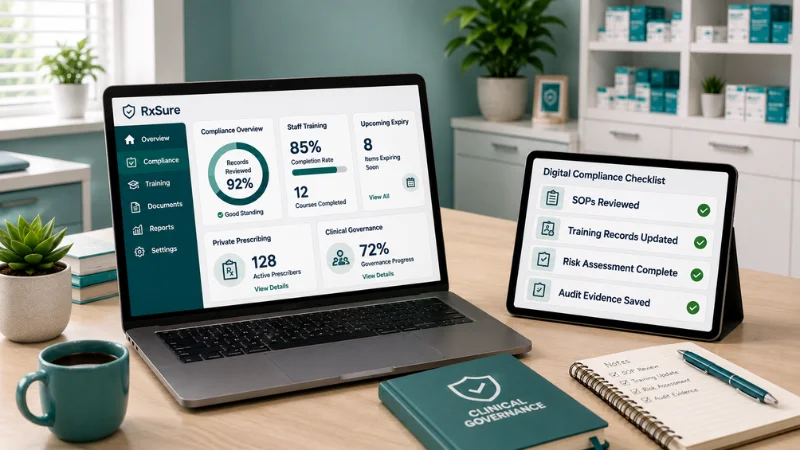
Preparing for a GPhC inspection requires systematic review of every aspect of pharmacy operations, from responsible pharmacist records and staff training documentation through to controlled drug registers and clinical governance frameworks. The inspection process typically involves an inspector visiting the pharmacy, reviewing documentation, observing practice, and interviewing staff members about their understanding of procedures and standards. Key areas that generate improvement notices include incomplete consultation records where clinical reasoning is not documented, out-of-date standard operating procedures that do not reflect current practice, gaps in staff training records particularly around safeguarding and clinical competencies, and inadequate incident reporting systems. A digital compliance tools addresses these risks by providing real-time visibility of documentation status, automated alerts when SOPs require review or staff training certificates approach expiry, and structured consultation templates that ensure every required clinical checkpoint is completed and recorded before a prescription can be issued. The dashboard also tracks responsible pharmacist logs, locum records, and equipment calibration schedules in a single audit-ready interface.
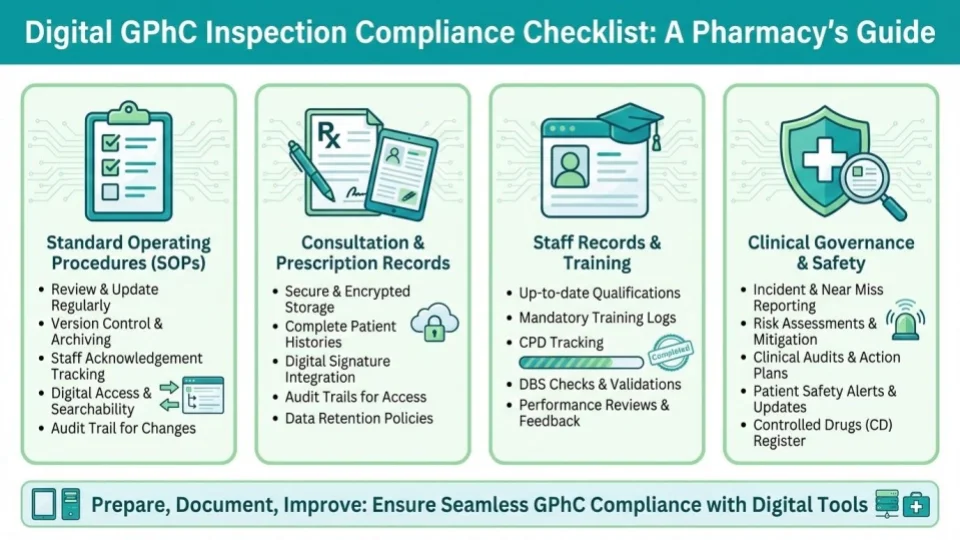
Use this checklist to ensure your pharmacy passes its GPhC inspection. Each item can be managed digitally with private prescription software like RxSure.
1. Standard Operating Procedures (SOPs)
- SOPs exist for every private service you offer (weight management, travel health, sexual health, etc.)
- SOPs are dated, version-controlled, and signed by the superintendent pharmacist
- All staff have read and signed acknowledgement of relevant SOPs
- SOPs are reviewed at least annually and updated when processes change
- SOPs are accessible to all staff (not buried in a folder nobody opens)
2. Consultation Records
- Every private consultation has a complete, dated record
- Records include: patient details, clinical assessment, safety checks performed, prescribing rationale, medication details, and prescriber identity
- Consultation notes are structured (not just “consulted and prescribed”)
- SmPC-guided consultation templates are used to ensure consistency
- Records are searchable and retrievable within seconds (not paper files in folders)
3. Prescription Records
- Every private prescription has a complete audit trail from consultation to dispensing
- Prescriptions include all legally required fields (patient details, medication, directions, prescriber details, date)
- Electronic prescriptions are stored securely with tamper-proof timestamps
- Repeat prescriptions are traceable to the original consultation
- A log of all private prescriptions issued is available for any date range
4. Staff Records
- All prescribers have current GPhC registration with appropriate prescribing annotations
- DBS checks are current for all staff with patient access
- Professional indemnity insurance is in place and documented
- Training records are up to date, including service-specific training
- CPD records demonstrate ongoing competence development
- Competence assessments have been conducted for each service offered
5. Clinical Governance
- Pre-screening questionnaires are completed before every consultation
- Contraindication checks are documented for every prescription
- Patient consent is recorded (not assumed)
- GP notification letters are sent for private prescriptions issued
- A clinical governance lead is identified and their role is documented
- Regular clinical audits are conducted (at least quarterly) with documented findings
6. Patient Safety
- An incident reporting system is in place and actively used
- Near-misses are recorded and reviewed alongside actual incidents
- Patient complaints procedure is documented and accessible
- Significant events are reviewed with documented learning outcomes
- Safeguarding procedures are in place with a named safeguarding lead
7. Premises & Equipment
- A private consultation room is available and suitable for confidential discussions
- Clinical equipment is calibrated and maintenance-logged (BP monitors, scales, thermometers)
- The consultation room has appropriate hand hygiene facilities
- IT systems are password-protected with role-based access controls
8. Data Protection
- ICO registration is current
- Privacy notices are displayed and given to patients
- Patient data is stored securely with encryption
- Access controls limit who can view patient records
- Data retention policies are documented and followed
- Procedures exist for data subject access requests
How Digital Tools Make Inspections Easier
The biggest challenge during inspections is not compliance itself, it’s proving compliance. Inspectors need evidence. With paper-based systems, pulling together consultation records, training logs, and audit trails can take hours. With digital systems, it takes seconds.
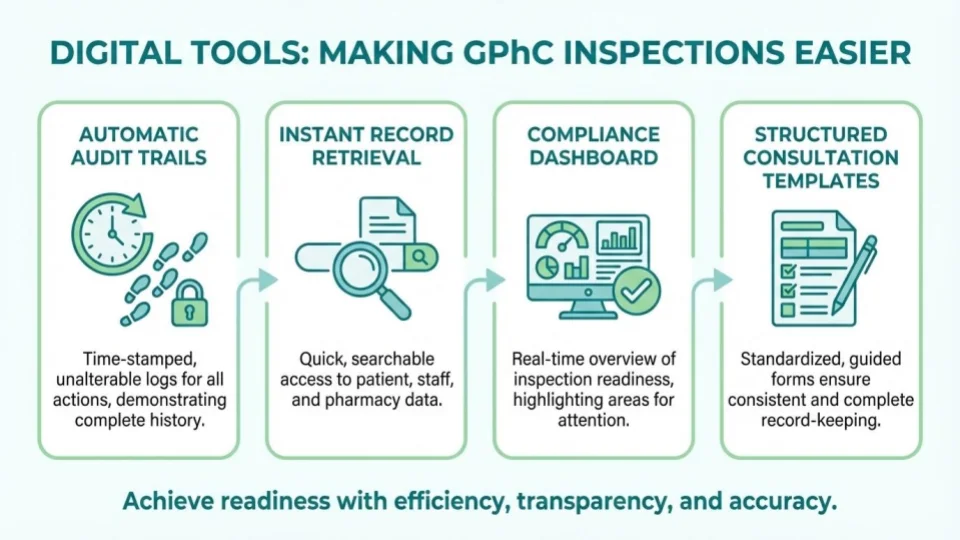
Automatic Audit Trails
Every consultation, prescription, and patient interaction is automatically logged with timestamps and user identities. No manual filing, no missing records, no gaps.
Instant Record Retrieval
When an inspector asks to see consultation records for a specific patient, date range, or service, you search and retrieve in seconds rather than searching through folders.
Compliance Dashboards
A compliance tools shows your status at a glance: staff certifications, upcoming expiries, audit completion, incident reports, and any flagged items. The superintendent pharmacist has immediate oversight across all services and sites.
Structured Consultation Templates
SmPC-guided templates mean every consultation follows a standardised, evidence-based structure. Inspectors see this as strong evidence of clinical governance, it demonstrates that safety checks cannot be skipped.
Common Inspection Findings to Avoid
Based on published GPhC inspection reports, these are the most frequent issues found in pharmacies offering private services:
- “Consultation records lack sufficient clinical detail”, Fix: Use structured templates that require clinical assessment documentation
- “No evidence of contraindication checks”, Fix: Embed safety checks into consultation workflows so they are automatically recorded
- “Staff training records are incomplete or out of date”, Fix: Use digital CPD tracking with expiry alerts
- “No regular audit of private prescribing activity”, Fix: Schedule quarterly audits and document findings digitally
- “GP notification not consistently sent”, Fix: Automate GP notification as part of the prescribing workflow
- “Incident reporting system not actively used”, Fix: Make incident reporting accessible and quick (one-click from dashboard)
Preparing for an Unannounced Inspection
The best preparation for an unannounced inspection is to be compliant every day, not just when you expect a visit. Digital compliance tools make this achievable by:
- Automating record-keeping so nothing is missed
- Sending alerts for upcoming expiries (DBS, insurance, training)
- Providing real-time compliance status visibility
- Making audit reports generateable on demand
With RxSure’s compliance features, your pharmacy is inspection-preparation every day, not just on inspection day.
Sources & References
- General Pharmaceutical Council. Standards for Pharmacy Professionals. GPhC, 2024.
- National Institute for Health and Care Excellence. NICE Guidelines. NICE, 2024.
- British National Formulary. BNF Online. NICE, 2024.
- Information Commissioner’s Office. Guide to UK GDPR. ICO, 2024.
Key Takeaways
- GPhC inspections assess compliance with all 5 Standards for Registered Pharmacies
- Private prescribing records, clinical governance, and audit trails receive extra scrutiny
- Digital systems make proving compliance instant rather than labour-intensive
- SmPC-guided consultation templates demonstrate strong clinical governance
- The most common findings relate to incomplete records, missing safety checks, and outdated training
- Being inspection-preparation every day is better than last-minute preparation
About this article: This article was prepared by the RxSure editorial team and is informed by publicly available UK healthcare guidance. Source references include GPhC, NICE, and BNF where cited. Content is reviewed periodically to reflect current information. This article is for general informational purposes and should not be relied upon as professional, medical, or regulatory advice. Last updated: 26 July 2026.