


Running private services across multiple pharmacy locations multiplies both the opportunity and the complexity. What works at a single site — ad hoc booking, paper records, manual compliance tracking — breaks down completely when you scale to two, five, or twenty locations. The pharmacies successfully scaling private services across multiple sites all share one thing in common: centralised digital infrastructure.
This guide covers the challenges of multi-site private service delivery and how private prescription software enables consistent, compliant, profitable services across every location.
The Multi-Site Challenge
When a pharmacy group decides to offer private services across all locations, they immediately face several challenges:
Consistency
Every site must deliver the same standard of service. A weight management consultation at your Manchester branch should follow the same clinical protocol as one in Birmingham. Without standardised systems, service quality varies by location — and your brand suffers.
Compliance at Scale
Each location has its own GPhC compliance obligations. You need audit trails, consultation records, and prescribing documentation for every site. If one location falls behind on compliance, it puts the entire group at risk during inspections.
Visibility
Group managers need to see what is happening across all sites: which services are being delivered, consultation volumes, revenue per location, compliance status, and staff performance. Without centralised reporting, you are flying blind.
Staff Management
Pharmacists may work across multiple locations. Their consultation records, prescribing activity, and compliance documentation need to follow them — not be locked to a single site’s system.
Patient Experience
Patients may visit different branches. Their consultation history, medication records, and booking preferences should be accessible at any location in the group.
What Multi-Site Pharmacy Software Must Do
1. Centralised Configuration
Service definitions, consultation templates, pricing, and clinical protocols should be configured once and deployed to all sites. When you update a weight management protocol, every location gets the update immediately — no manual rollout required.
2. Site-Specific Customisation
While core services are standardised, each location may have different:
- Opening hours and appointment availability
- Staff rosters and prescriber schedules
- Service offerings (not every site may offer every service)
- Local marketing and booking pages
The platform should allow site-level customisation within the group framework.
3. Unified Patient Records
A single patient record accessible across all locations. When a patient books at a different branch, the consulting pharmacist sees their full history: previous consultations, medications, allergies, and outcomes.
4. Group-Level Reporting
Dashboard showing:
- Revenue by site — which locations are performing and which need attention
- Consultation volumes — demand patterns by service, day, and time
- Compliance status — audit readiness across all sites
- Staff utilisation — prescriber appointment fill rates
- Patient metrics — new vs returning, satisfaction, retention
5. Role-Based Access Control
Different team members need different access levels:
- Group administrators — full access to all sites, configuration, and reporting
- Site managers — access to their location’s data and local configuration
- Pharmacists/prescribers — access to patient records and consultation tools
- Reception staff — access to booking and basic patient information
6. Centralised Compliance Management
Compliance dashboards that show group-wide status: which sites have completed their audits, which have outstanding documentation gaps, and which are approaching GPhC inspection deadlines.
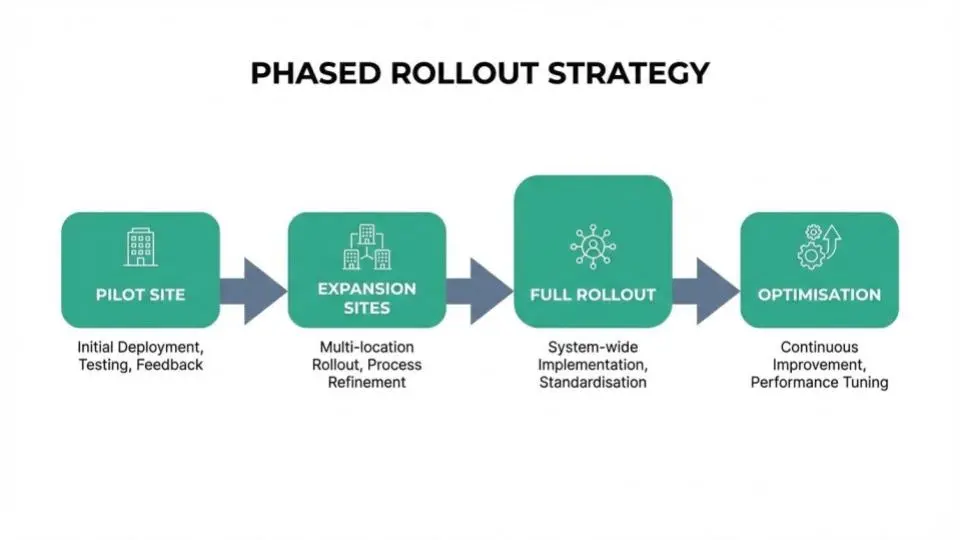
Scaling Private Services: A Phased Approach
Phase 1: Pilot at One Site (Weeks 1–4)
- Choose your strongest location — best team, highest footfall, most engaged pharmacist
- Set up the platform with 2–3 core services
- Train the team and run the services for one month
- Document what works, what does not, and what needs adjusting
- Refine templates, workflows, and pricing based on real experience
Phase 2: Expand to 2–3 Sites (Weeks 5–8)
- Deploy the refined configuration to additional sites
- Train new site teams using the pilot site’s learnings
- Assign a champion pharmacist at each new site
- Monitor closely and provide hands-on support during the first two weeks
Phase 3: Full Group Rollout (Weeks 9–16)
- Roll out to all remaining locations
- Establish group-level reporting cadence (weekly metrics review)
- Create peer learning networks between sites
- Introduce performance benchmarking across locations
Phase 4: Optimise and Expand (Ongoing)
- Use group data to identify high-performing services and replicate across all sites
- Add new services based on demand data
- Negotiate better supplier terms based on group volume
- Share best practices and case studies between sites
Common Multi-Site Pitfalls
- Rolling out everywhere at once — always pilot first, then expand gradually
- No central ownership — assign a group-level private services manager
- Inconsistent training — create standardised training materials and use the pilot site for hands-on learning
- Ignoring local differences — some services may work better in certain demographics; allow site-level service selection
- No performance tracking — without data, you cannot identify underperforming sites or replicate success
- Separate systems per site — using different platforms at different locations destroys your ability to manage consistently
The Financial Case for Multi-Site Private Services
The economics of multi-site private services are compelling:
- Shared infrastructure costs — one platform subscription covers all sites, reducing per-site cost
- Economies of learning — each new site benefits from the group’s accumulated experience
- Cross-referral — patients can be directed to the nearest location offering their needed service
- Supplier negotiation — group purchasing power for medications and supplies
- Brand building — consistent service quality across locations builds a recognisable private services brand
A pharmacy group with 5 locations, each generating £5,000/month in private services, produces £300,000 per year in additional revenue — a transformative addition to the group’s bottom line.
Key Takeaways
- Multi-site private services require centralised digital infrastructure — site-by-site manual systems do not scale
- Standardise core services and clinical protocols while allowing site-level customisation
- Unified patient records and group-level reporting are essential for consistency and visibility
- Always pilot at one site before expanding — refine workflows based on real experience
- Role-based access control ensures appropriate data access across the group
- RxSure supports multi-site pharmacy groups with centralised management and site-level flexibility
Ready to scale private services across your pharmacy group? Start your free 3-month RxSure trial and see how one platform powers every location.