

Online GP Services Software: What Platform Do You Actually Need?
NHS GP systems are overkill for private prescribing. Compare platform options for independent prescribers — what features matter, what to avoid, and how to go live fast.
TL;DR: Most “GP software” is built for NHS workflows and is overkill for private prescribing. If you are a GP or prescriber starting private services, you need a platform designed for private consultations, not an NHS system stripped of features. This article compares the options and explains what actually matters.
The phrase “online GP services software” gets searched thousands of times per month in the UK. Behind that search query are two very different groups: NHS practices looking to digitise existing workflows, and independent prescribers (GPs, pharmacists, nurses) wanting to launch private clinical services online. These groups need fundamentally different technology, but marketing materials rarely make this distinction.
This guide is for the second group. If you are a qualified prescriber looking to offer private consultations and prescribing services, here is what you actually need, and what you can safely ignore.
NHS GP Software vs Private Prescribing Platforms: The Core Difference
NHS clinical systems (EMIS Web, SystmOne, Vision) are designed around the QOF (Quality and Outcomes Framework), NHS contractual obligations, GP2GP record transfers, and integration with the NHS Spine. They cost thousands per year in licensing, require complex setup, and come with features you will never use in private practice.
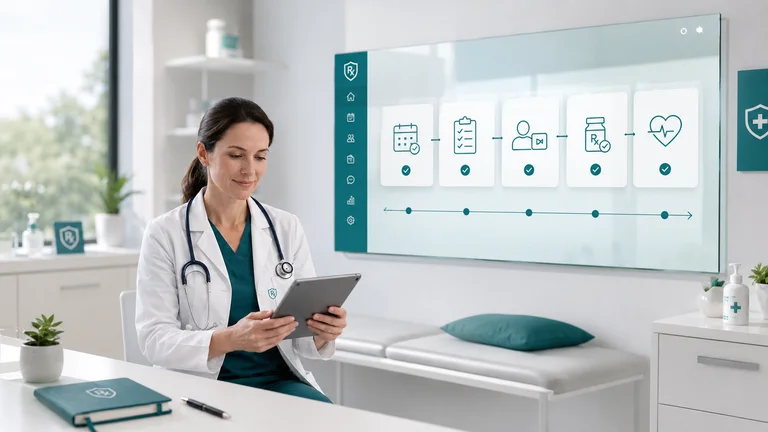
Private prescribing platforms are purpose-built for a different workflow: patient books → pre-screening questionnaire → clinical consultation → prescribe or refer → follow-up. No QOF templates. No GP2GP. No UDA targets. Just clinical decision-making supported by clean, efficient technology.
| Feature | NHS GP System | Private Prescribing Platform |
|---|---|---|
| Setup time | Weeks to months | Under 1 hour |
| Monthly cost | £500–£2,000+ | £199 flat rate |
| Per-prescription fees | Varies | None (RxSure) |
| NHS Spine integration | Required | Not needed for private |
| QOF/contract compliance | Built-in | Not applicable |
| Patient self-booking | Limited/bolt-on | Native |
| Pre-screening questionnaires | Manual or third-party | Built-in, customisable |
| Private prescription generation | Workaround | Core feature |
What a Private Prescribing Platform Must Do
Strip away the NHS complexity, and the requirements for private prescribing are clear and specific. Any platform you choose should deliver these capabilities without requiring IT consultants or weeks of configuration:
1. Patient Registration and Verification
The GPhC and GMC both require prescribers to verify patient identity before prescribing at a distance. Your platform should capture patient demographics, verify identity through a compliant mechanism, and create a searchable patient record, all before the first consultation begins.
2. Pre-Screening Questionnaires
Efficient private services use structured questionnaires to screen patients before they reach a prescriber. This achieves two things: it filters out patients who are clinically inappropriate (saving prescriber time and reducing risk), and it provides documented evidence that appropriate checks were performed (supporting your clinical governance).
The questionnaire should be condition-specific, evidence-based, and capable of flagging red flags that require immediate escalation or referral.
3. Consultation and Clinical Notes
Whether you conduct consultations via video, telephone, or asynchronous messaging, the platform must capture complete clinical notes. The GMC’s Good Medical Practice (2024) and the GPhC’s Standards for Pharmacy Professionals both require adequate records of every clinical encounter. This means: presenting complaint, relevant history, clinical assessment, prescribing rationale, safety-netting advice, and follow-up plan.
4. Prescription Generation
Private prescriptions must meet specific legal requirements under the Human Medicines Regulations 2012. Your platform should generate prescriptions that include all mandatory fields: prescriber name and address, patient details, date, medicine details (name, form, strength, quantity, dose), and the prescriber’s signature (electronic signatures are acceptable for private prescriptions).
5. Audit Trail and Compliance
Every action on the platform, every login, consultation, prescription, amendment, should be timestamped and attributable to a specific user. This audit trail is non-negotiable for GPhC compliance. When inspectors ask to see your records for Patient X from six months ago, you should be able to retrieve the complete interaction in seconds.
Who Is This Actually For?
Private prescribing platforms serve a wider range of professionals than many people realise:
- GPs offering private services alongside or instead of NHS work, increasingly common as partnership income declines and workload increases
- Pharmacist Independent Prescribers launching clinical services through community pharmacies or standalone practices
- Nurse Independent Prescribers providing specialist services (aesthetics, travel health, sexual health, minor illness)
- Dentists with prescribing authority offering facial aesthetics or oral medicine services
- Pharmacy groups rolling out prescribing services across multiple sites, see our guide on pharmacy group solutions
Red Flags When Evaluating Platforms
Not all platforms are created equal. Watch for these warning signs during your evaluation:
- Per-prescription fees, these erode your margin on every consultation and make revenue unpredictable. A flat monthly fee (like RxSure’s £199/month) lets you scale without increasing platform costs.
- Long-term contracts, avoid platforms that lock you into 12 or 24-month commitments before you’ve proven the business model works.
- No UK data hosting, health data must be processed and stored in compliance with UK GDPR. Ask where servers are located and who the data processor is.
- No clinical governance support, a platform that only handles prescriptions without supporting the clinical assessment workflow is incomplete.
- Outdated user interface, if the platform looks like it was built in 2010, the underlying architecture probably was too. Modern platforms should work seamlessly on tablets and phones, not just desktop computers.
The “Build vs Buy” Question
Some clinics consider building custom software. In nearly all cases, this is a mistake for private prescribing services. Here is why:
- Regulatory compliance is complex, medical device regulations (MHRA), data protection (UK GDPR), prescription format requirements (Human Medicines Regulations 2012), and accessibility standards (WCAG) all apply. Getting one wrong is a compliance failure.
- Development costs are high, a compliant clinical platform costs £50,000–£200,000+ to build from scratch, plus ongoing maintenance and security updates.
- Time to market suffers, 6-12 months of development versus going live in days with an existing platform.
- Ongoing burden, every regulatory change, security patch, and feature request becomes your problem indefinitely.
Unless you are a large organisation with specific needs that no existing platform addresses, buying (subscribing to) a proven platform is the rational choice. Your clinical expertise is your competitive advantage, not your software development capability.
Getting Started: A Practical Path
- Define your services, what conditions will you treat? What patient populations? This determines your platform requirements.
- Check your qualifications, ensure your prescribing annotation is current and your professional indemnity covers the planned services.
- Trial platforms, most offer free trials or demos. Use them with realistic scenarios, not just a quick click-through. Try RxSure free.
- Build governance first, SOPs, formulary, safeguarding policy, and clinical audit framework should be in place before you see patients.
- Start small, launch with one or two clinical areas where you have deep competence, then expand as your practice grows.
Frequently Asked Questions
Do I need NHS clinical system experience to use a private platform?
No. Private prescribing platforms are designed to be intuitive. If you can use email and online banking, you can use a modern prescribing platform. Most prescribers are live within an hour of signing up. NHS system experience is irrelevant, the workflows are fundamentally different.
Can I use a private platform alongside my NHS work?
Yes, provided you maintain clear separation between NHS and private activity. The GMC and GPhC require transparency about private services and that private work does not compromise your NHS obligations. Many GPs and pharmacists run private prescribing services outside NHS contracted hours.
Is the software a medical device?
Prescribing platforms that provide clinical decision support may qualify as Class I medical devices under the Medical Devices Regulations 2002 (as amended). Established platforms like RxSure handle this regulatory classification themselves, you don’t need to worry about MHRA registration as a user of the platform.
What about integration with NHS records?
For private prescribing, you do not need integration with the NHS Spine or GP clinical systems. You do have a professional obligation to notify the patient’s GP of any prescriptions issued (GMC Good Practice in Prescribing, paragraph 59). This can be done via secure letter or electronic communication, your platform should support this workflow.
How many patients can I see per month on a flat-rate platform?
With RxSure’s flat £199/month pricing, there is no limit on the number of consultations or prescriptions. Whether you see 10 patients or 500, the platform cost remains the same. This makes the economics straightforward: your revenue scales with your clinical capacity, not your software costs.
References
- General Medical Council. Good Medical Practice. 2024. gmc-uk.org
- General Medical Council. Good Practice in Prescribing and Managing Medicines and Devices. 2021. gmc-uk.org
- General Pharmaceutical Council. Standards for Pharmacy Professionals. 2017. pharmacyregulation.org
- Human Medicines Regulations 2012 (SI 2012/1916). legislation.gov.uk
- MHRA. Guidance on Medical Device Software. 2023. gov.uk
Start Prescribing in Under 1 Hour
RxSure is built for private prescribers, not repurposed NHS software. Flat £199/month, zero per-prescription fees, no long-term contracts.