
Zero Platform Fees: Why Flat-Rate Prescribing Software Wins
Per-prescription fees punish growth. Compare prescribing platform pricing models and see why flat-rate software at £199/month delivers better economics for growing practices.
TL;DR: Per-prescription fees punish growth. A flat-rate prescribing platform (£199/month with RxSure) means your costs stay fixed as your patient volume increases, improving your margin with every additional consultation. This article breaks down the economics and explains why the pricing model matters more than the headline price.
When evaluating prescribing platforms, most prescribers focus on features first and pricing second. This is backwards. The pricing model determines whether your platform becomes cheaper per patient as you grow (flat rate) or more expensive per patient as you grow (per-prescription). Over a typical prescribing career, this single decision can represent tens of thousands of pounds.
This article provides a transparent financial analysis of prescribing platform pricing models, no vague claims, just arithmetic.
The Three Pricing Models Explained
Model 1: Per-Prescription Fees
You pay a fee (typically £2–£5) every time a prescription is issued through the platform. Some platforms also charge per consultation, per patient registration, or per SMS sent. The headline “starting from £X” looks attractive until you do the monthly maths.
Economics: Your platform cost is directly proportional to your output. Issue more prescriptions → pay more. There is no economy of scale. Your busiest months are your most expensive months.
Model 2: Tiered Subscription
You pay a monthly subscription that includes a cap, say 50 prescriptions. Exceed the cap and you pay overage fees, or you must upgrade to the next tier. This model appears predictable until you hit the tier boundary.
Economics: Predictable within your tier, but growth triggers step-changes in cost. The “dead zone” between your usage and the next tier cap means you are often paying for capacity you don’t use.
Model 3: Flat Rate (Zero Platform Fees)
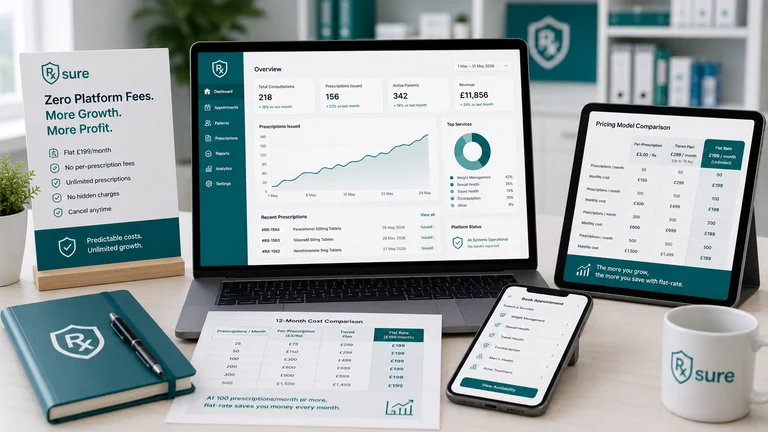
RxSure charges £199/month. No per-prescription fees. No per-consultation charges. No overage. No tier limits. Whether you see 10 patients or 500, issue 5 prescriptions or 300, the cost is £199.
Economics: Your cost per prescription decreases as volume increases. At 50 prescriptions/month, your platform cost is £3.98/Rx. At 200 prescriptions/month, it drops to £1.00/Rx. At 500, it’s £0.40/Rx. The more you grow, the more the model rewards you.
12-Month Cost Comparison
Let us model three growth scenarios for a prescriber who starts at 30 prescriptions per month and grows by 10% each month (a conservative growth rate for a new service):
| Month | Prescriptions | Per-Rx (£3/Rx) | Tiered (£299 for 75 Rx) | Flat Rate (£199) |
|---|---|---|---|---|
| Month 1 | 30 | £90 | £299 | £199 |
| Month 3 | 36 | £108 | £299 | £199 |
| Month 6 | 48 | £144 | £299 | £199 |
| Month 9 | 64 | £192 | £299 | £199 |
| Month 12 | 85 | £255 | £499* | £199 |
| 12-Month Total | 614 | £1,842 | £3,888 | £2,388 |
*Tier upgrade triggered when volume exceeds 75 Rx/month cap
In this scenario, the per-prescription model is cheapest initially but the flat rate becomes the best value as volume grows. More importantly, the flat rate is the only model where you know exactly what you will pay every month, regardless of how successful your practice becomes.
The Hidden Costs of “Cheap” Platforms
Low headline prices often conceal additional charges that erode value:
- SMS charges, £0.05–£0.10 per message adds up fast when you send appointment reminders, follow-ups, and prescription notifications
- Storage fees, charges for document storage, clinical images, or records beyond a base limit
- Feature access fees, advanced reporting, API access, or multi-prescriber management behind higher tiers
- Support charges, “priority support” only available on premium plans; basic tier gets email-only with 48-hour response
- Integration fees, connecting to payment processors, booking widgets, or communication tools costs extra
With a genuine flat-rate model, these should all be included. Ask specifically: “Is there anything I would pay for beyond the monthly subscription?” If the answer is not a clean “no,” the headline price is misleading.
Why Per-Prescription Fees Create Perverse Incentives
Beyond pure economics, per-prescription pricing creates subtle behavioural incentives that can compromise clinical practice:
- Reluctance to re-prescribe, if issuing a corrected prescription costs you £3-5, you might hesitate to correct an error or adjust a dose mid-cycle. The platform fee should never be a factor in clinical decision-making.
- Combining prescriptions inappropriately, putting multiple items on one prescription to avoid per-Rx charges, when clinically separate prescriptions would be more appropriate
- Discouraging follow-up prescribing, routine follow-up prescriptions for chronic conditions should be straightforward, not a cost event
Clinical decisions should be driven by patient need, not platform economics. A flat-rate model removes the platform from the clinical equation entirely.
When Does Flat Rate Not Make Sense?
In the interest of fairness, there are scenarios where per-prescription might be more cost-effective:
- Very low volume prescribing (under 20 prescriptions per month consistently), at £3/Rx, 20 prescriptions costs £60 versus £199 flat rate
- Seasonal or sporadic prescribing with months of no activity, paying £199/month when issuing zero prescriptions is wasteful
- Testing a new service before committing, though a free trial (like RxSure offers) eliminates this concern
For any prescriber who intends to build a sustainable practice, one that grows over time, the flat-rate model becomes superior quickly and increasingly so over time.
What £199/Month Gets You with RxSure
To ground this comparison in specifics, here is what is included in RxSure’s flat monthly rate:
- Unlimited patient registrations and consultations
- Unlimited prescription generation, no per-Rx fees
- Patient self-service booking and pre-screening questionnaires
- Clinical consultation templates (customisable)
- Full audit trail and clinical records
- Patient communication (reminders, follow-ups)
- GP notification letter generation
- Reporting and prescribing analytics
- UK data hosting (GDPR compliant)
- Support included, no premium tier required
- No minimum contract term
Frequently Asked Questions
Is £199/month really unlimited?
Yes. There are no hidden caps, fair-use clauses, or throttling. Whether you issue 10 prescriptions or 1,000 in a month, the cost remains £199. The model works because operational costs per additional prescription are negligible for a well-architected platform.
What if I need multiple prescriber accounts?
Multi-prescriber pricing is available for pharmacy groups and clinics with multiple practitioners. Contact RxSure for group pricing, it remains flat-rate, just scaled for your team size.
Are there setup fees?
No. Account creation, configuration, and onboarding are included in the subscription. You can be live and consulting within an hour of signing up.
Can I cancel monthly?
Yes. No minimum term, no exit fees, no notice period beyond the current billing cycle. Your patient data remains accessible for export in compliance with UK GDPR data portability requirements.
How does RxSure make money on flat-rate if usage is unlimited?
The platform is built on modern, scalable infrastructure where the marginal cost of each additional prescription is minimal. The subscription model aligns incentives: RxSure succeeds when prescribers succeed and stay subscribed long-term, not by extracting fees from individual clinical decisions.
References
- General Pharmaceutical Council. Digital Markets, Competition and Consumers Act 2024, provisions on subscription transparency and drip pricing. legislation.gov.uk
- NHS Business Services Authority. Prescription Cost Analysis. 2023. nhsbsa.nhs.uk
- General Pharmaceutical Council. Standards for Registered Pharmacies. Standard 3: Environment and Equipment. pharmacyregulation.org
Predictable Costs. Unlimited Growth.
Flat £199/month. No per-prescription fees. No surprises. Start your free trial and see the platform in action.