

Patient-Facing GP Apps vs Provider Platforms: Which Model Wins for Your Practice?
GPs and prescribers offering private online services face a choice: join a patient-facing app where the app owns the patient, or use a provider platform where you own everything. This guide compares…
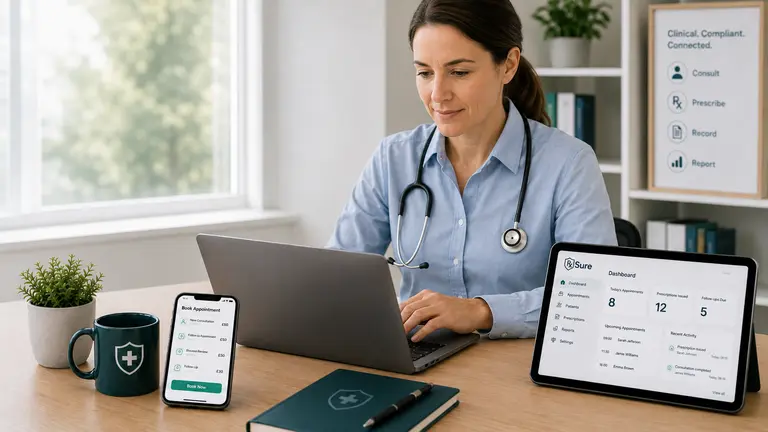
TL;DR: GPs and prescribers looking to offer private online services face a fundamental choice: join a patient-facing app (where the app owns the patient relationship and brand) or use a provider platform (where you own the patients, the brand, and the pricing). Patient-facing apps suit locum-style work with minimal admin. Provider platforms like RxSure suit clinicians building a practice, with full revenue control at a flat £29.99/mo (plus £1.25 per consultation) and zero commission.
The market for private virtual healthcare in the UK has expanded rapidly. NHS waiting lists exceeded 7.6 million in early 2024, and patients are increasingly willing to pay for timely access to a clinician.[1] For GPs and independent prescribers considering private online services, the first strategic decision is which model to operate under.
There are fundamentally two approaches: join a patient-facing app as a contracted clinician, or use a provider platform to build and run your own practice. Each model has distinct implications for your income, your clinical autonomy, and whether you are building an asset or simply trading time for money.
The Two Models Explained
Model 1: Patient-Facing Apps
In this model, a technology company builds a consumer-facing app or website. Patients download the app, search for available clinicians, and book appointments. The app handles all marketing, patient acquisition, and often payment processing. The GP or prescriber is essentially a contractor providing clinical services under the app’s brand.
Key characteristics of this model:
- The app owns the patient relationship, patients associate their experience with the app brand, not with you personally
- The app sets the pricing or takes a significant commission (often 30–50% of the consultation fee)
- You have limited control over your schedule, the platform may assign patients or set availability requirements
- You cannot build a patient base, if you leave the app, your patients stay with the platform
- Marketing and patient acquisition are handled for you
Model 2: Provider Platforms
In this model, you use a technology platform as infrastructure to run your own practice. The platform provides the tools, booking, e-prescribing, video consultation, clinical documentation, payment processing, but you are the brand. Patients book with your practice, see your name and branding, and return to you for follow-ups.
Key characteristics of this model:
- You own the patient relationship, your name, your brand, your practice
- You set the pricing, charge what you believe your expertise is worth
- You keep all revenue minus a flat subscription fee (no per-consultation commission)
- You control your schedule, services, and clinical approach
- You are responsible for your own patient acquisition and marketing
RxSure operates on this model. For £29.99 per month (plus £1.25 per consultation) with no commission, you get a complete POM-based private prescribing platform under your own brand. Explore the full feature set.
Feature Comparison: App Model vs Provider Platform Model
| Feature | Patient-Facing App Model | Provider Platform Model (e.g. RxSure) |
|---|---|---|
| Branding / White-label | App’s brand, you are a listed clinician | Your practice name, logo, and branding throughout |
| Patient ownership | App owns the patient database | You own and retain all patient data |
| Pricing model | App sets prices or takes 30–50% commission | Flat £29.99/mo (plus £1.25 per consultation), zero commission on consultations |
| E-prescribing (POM) | Varies, some apps do not support POM prescribing | Full POM-based private prescribing built in |
| Video consultation | Usually included (app’s own system) | Integrated video consultation |
| Booking control | Limited, app may assign patients or set slots | Full control over your availability and booking rules |
| Multi-clinic support | Rarely supported | Manage multiple locations from one dashboard |
| Revenue control | App determines your earnings per consultation | You set all fees and keep 100% of consultation revenue |
| Compliance tools | App provides basic documentation | Clinical questionnaires, consent management, audit trails aligned to NICE guidance |
Revenue Comparison: The Numbers
The financial difference between the two models becomes stark when you run the numbers. Consider a prescriber offering 20 private consultations per week at a standard fee of £60 per consultation:
| Metric | Patient-Facing App (40% commission) | Provider Platform (£29.99/mo (plus £1.25 per consultation) flat) |
|---|---|---|
| Gross weekly revenue (20 × £60) | £1,200 | £1,200 |
| Platform cost per week | £480 (40% commission) | £46 (9.99/mo (plus .25 per consultation) ÷ 4.33 weeks) |
| Net weekly revenue | £720 | £1,154 |
| Net monthly revenue | £3,120 | £5,001 |
| Annual difference | Provider platform earns £22,572 more per year | |
Even at lower volumes, say 10 consultations per week, the provider platform model generates significantly more net income. The break-even point for RxSure is approximately 4 consultations per month at £60 each.
When Each Model Makes Sense
The App Model May Suit You If…
- You want locum-style flexibility, log on when you want, see patients, log off
- You have no interest in building a practice or brand
- You want zero responsibility for marketing or patient acquisition
- You are comfortable earning a fraction of the consultation fee in exchange for convenience
- You are supplementing NHS income with occasional private work
The Provider Platform Model Suits You If…
- You are building (or planning to build) a private prescribing practice
- You want to own the patient relationship and build long-term loyalty
- You want full control over pricing, services, and clinical approach
- You want to maximise revenue per consultation
- You have (or are willing to develop) a referral network or marketing strategy
- You operate a clinic, pharmacy, or multi-prescriber practice
For most prescribers who are serious about private practice, the provider platform model is the better long-term investment. You are building an asset, a patient base, a reputation, and a brand, rather than renting someone else’s.
Building Your Own Platform vs Using a Ready-Made Solution
Some clinicians consider commissioning a bespoke platform. While this gives maximum control, the costs and timelines are substantial:
| Factor | Custom Build | Ready-Made Platform (e.g. RxSure) |
|---|---|---|
| Upfront cost | £10,000–£50,000+ | £0 (free trial, then £29.99/mo (plus £1.25 per consultation)) |
| Time to go live | 3–12 months | Under 1 hour |
| Ongoing maintenance | £500–£2,000/mo (developer, hosting, security) | Included in subscription |
| Regulatory updates | Your responsibility to implement | Platform team handles updates |
| E-prescribing integration | Complex, requires NHS/PDS integration work | Built in and ready to use |
| Risk | High, project delays, budget overruns common | Low, proven platform, immediate availability |
For the vast majority of clinicians and small practices, a purpose-built platform like RxSure offers the best balance of cost, speed, and capability. Custom builds only make sense for large organisations with dedicated technology teams and budgets.
Own Your Practice. Own Your Patients. Own Your Revenue.
RxSure gives you a complete private prescribing platform under your own brand. Live in 1 hour. £29.99/mo (plus £1.25 per consultation) flat. Zero commission.
Frequently Asked Questions
Can I use both models at the same time?
Yes. Some clinicians start on a patient-facing app to gain experience with virtual consultations and gradually transition to their own platform as they build confidence and a patient base. There is no exclusivity requirement with RxSure, you can use it alongside any other arrangement.
Do I need CQC registration to offer private online consultations?
In England, the Care Quality Commission (CQC) requires registration for providers of regulated activities, which can include remote consultations and prescribing. The CQC’s scope of registration guidance sets out when registration is required.[2] If you are prescribing POM privately via remote consultation, you should check whether your specific model of practice requires CQC registration. Pharmacist independent prescribers working within a registered pharmacy may already be covered under the pharmacy’s GPhC registration.
What does the GMC say about remote prescribing?
The GMC’s guidance on prescribing via telephone, video-link, or online states that the same standards apply as for face-to-face prescribing. You must make an adequate assessment of the patient’s condition, ensure there is sufficient justification for prescribing, and maintain proper records.[3] For non-medical prescribers, equivalent guidance from the relevant professional body (GPhC, NMC) applies.
How do patients find my practice if I use a provider platform?
You are responsible for marketing your own practice, but this is simpler than it sounds. Most successful prescribers on RxSure generate patients through: their existing patient base (pharmacies and clinics), Google search (local SEO), social media (particularly Facebook and Instagram), and referrals from other healthcare professionals. RxSure provides guidance on effective marketing strategies for private prescribing services.
What if I want to add more clinicians to my practice later?
RxSure supports multi-prescriber practices. You can add additional clinicians to your account, each with their own availability, services, and patient lists. This makes it straightforward to scale from a solo practice to a multi-clinician operation without changing platforms. Visit our clinics page for more information.
References
- NHS England. Consultant-led Referral to Treatment Waiting Times. Available at: england.nhs.uk/statistics/statistical-work-areas/rtt-waiting-times
- Care Quality Commission. Scope of registration. Available at: cqc.org.uk/guidance-providers/registration/scope-registration
- General Medical Council. Prescribing guidance: remote prescribing via telephone, video-link or online. Available at: gmc-uk.org/ethical-guidance
- NHS Digital. Digital services for the NHS. Available at: digital.nhs.uk