

Private Dermatology Prescribing: How Pharmacists & GPs Can Offer Skin Services Online
NHS dermatology waits exceed 18 months. Pharmacist IPs and GPs can offer private skin consultations online for acne, rosacea, eczema, and more. This guide covers conditions, workflows, clinical safety, revenue, and platform…
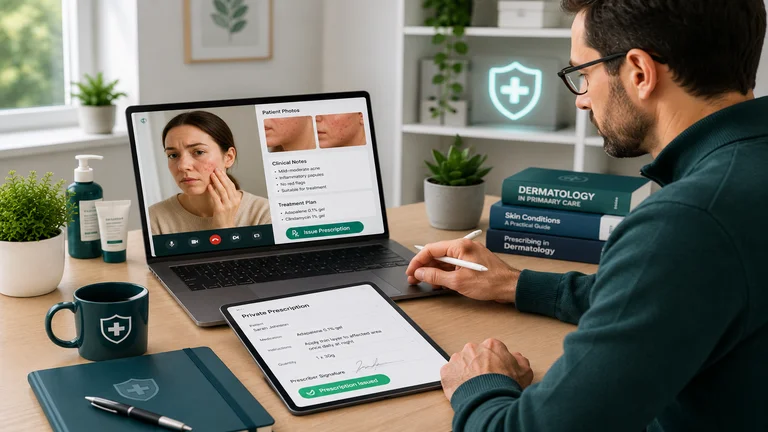
TL;DR: NHS dermatology waiting lists now exceed 18 months in many areas. Pharmacist independent prescribers and GPs can fill the gap by offering private skin consultations online, covering acne, rosacea, eczema, mild psoriasis, and fungal infections. With the right platform, you can accept photo-based consultations, prescribe safely, and generate £3,000–6,000/month in additional revenue. This guide covers which conditions you can treat, the consultation workflow, clinical safety, and how RxSure supports dermatology services.
Why Dermatology Demand Is Surging
Skin conditions are among the most common reasons for GP consultations in the UK, accounting for roughly 13–15% of all primary care presentations.[1] Yet NHS dermatology services face significant capacity constraints. According to NHS England referral-to-treatment data, the median wait for a first outpatient dermatology appointment exceeded 18 weeks in 2024, with some regions reporting waits of 40 weeks or longer.[2]
For patients with common, non-urgent skin conditions, acne that affects their confidence, eczema flare-ups that disrupt sleep, or persistent fungal infections, waiting months for an NHS appointment is impractical. Many are willing to pay for faster access to clinical expertise.
This creates a genuine clinical and commercial opportunity for pharmacist independent prescribers (IPs) and GPs who hold the competence to assess and prescribe for common dermatological conditions.
Conditions Pharmacist IPs Can Prescribe For
As an independent prescriber registered with the GPhC, GMC, or NMC, you can prescribe any medicine within your clinical competence, including prescription-only medicines (POMs) for skin conditions.[3] The key principle is that you only prescribe within your area of competence and refer when a condition exceeds your expertise.
The following conditions are commonly managed by prescribers offering private dermatology services:
Acne Vulgaris
Mild-to-moderate acne is one of the most frequently requested private dermatology consultations. Treatment options within a prescriber’s scope include topical retinoids (adapalene, tretinoin), topical antibiotics (clindamycin), benzoyl peroxide combinations, and oral antibiotics (lymecycline, doxycycline) for moderate cases.[4]
Important: Isotretinoin (Roaccutane) is a specialist-only medication. It requires baseline blood tests, pregnancy prevention programmes, and specialist monitoring. Prescribers offering private acne services should have a clear referral pathway for patients who may need isotretinoin.[4]
Rosacea
Rosacea affects approximately 1 in 10 people in the UK. Prescribers can offer topical treatments such as metronidazole gel, ivermectin cream (Soolantra), azelaic acid, and brimonidine gel for erythema. Oral doxycycline at sub-antimicrobial doses (40mg MR) is appropriate for papulopustular rosacea.[5]
Eczema and Dermatitis
Atopic eczema is the most common inflammatory skin condition, affecting up to 20% of children and 10% of adults in the UK.[6] Prescribers can manage flare-ups with emollients, topical corticosteroids (mild to potent depending on body site), calcineurin inhibitors (tacrolimus, pimecrolimus), and step-up/step-down regimens aligned with NICE guidance.
Psoriasis (Mild)
Mild plaque psoriasis affecting less than 10% of body surface area can be managed in primary care. Treatment options include vitamin D analogues (calcipotriol), combination preparations (calcipotriol/betamethasone), coal tar preparations, and short-contact dithranol.[7] Moderate-to-severe psoriasis requiring systemic therapies (methotrexate, biologics) must be referred to a dermatologist.
Fungal Skin Infections
Dermatophyte infections (tinea corporis, tinea cruris, tinea pedis) and candidal infections are straightforward to diagnose clinically and treat with topical antifungals (clotrimazole, miconazole, terbinafine cream) or oral terbinafine/itraconazole for extensive or nail infections.[8]
The Online Consultation Workflow
Offering dermatology services online follows a structured clinical workflow. The process should be designed to ensure patient safety while being convenient enough that patients choose your service over alternatives.
Step 1: Patient Submits a Consultation Request
The patient books an appointment through your online booking page and completes a pre-consultation questionnaire. For dermatology, this should include:
- Duration and location of the skin concern
- Symptoms (itching, pain, bleeding, spreading)
- Previous treatments tried (OTC and prescription)
- Relevant medical history and current medications
- Photographs of the affected area (minimum 2–3 clear images)
Step 2: Clinical Review
You review the questionnaire responses and photographs. For straightforward presentations (e.g., typical acne, clear fungal infection), an asynchronous review may be sufficient. For ambiguous presentations, schedule a video or telephone consultation to gather additional history.
Step 3: Clinical Decision
Based on your assessment, you make one of three decisions:
- Prescribe, issue a private prescription via the platform
- Advise, provide self-care advice and OTC recommendations
- Refer, signpost to the patient’s GP or a specialist dermatologist
Step 4: Follow-Up
Many skin conditions require follow-up to assess treatment response. Schedule a review at 4–8 weeks depending on the condition and treatment prescribed. Follow-up consultations are typically shorter and can be priced lower than initial assessments.
Photo Consultation and Clinical Safety
Photo-based dermatology consultations (teledermatology) have a strong evidence base. A 2020 systematic review found that store-and-forward teledermatology achieved diagnostic concordance rates of 50–90% compared with face-to-face consultation, depending on the condition.[9] For common conditions like acne, eczema, and fungal infections, diagnostic accuracy is at the higher end of this range.
To ensure clinical safety with photo-based consultations:
- Image quality requirements, specify minimum resolution, lighting conditions, and angles. Reject and request re-submission if images are inadequate for assessment
- Informed consent, patients must consent to the limitations of remote assessment and understand that a face-to-face examination may be recommended
- Red flags protocol, establish clear criteria for when to refer rather than prescribe remotely. Any pigmented lesion with ABCDE warning signs (asymmetry, border irregularity, colour variation, diameter >6mm, evolution) must be referred urgently
- Data security, patient photographs are sensitive personal data under UK GDPR. They must be stored securely, encrypted, and only accessible to authorised clinicians
- Audit trail, maintain a complete record of images received, clinical assessment, prescribing decisions, and follow-up actions
Revenue Opportunity
Private dermatology consultations command reasonable fees because patients are paying for clinical expertise, convenience, and speed, not just a prescription. Typical pricing in the UK private market:
| Service | Typical Fee | Consultation Time |
|---|---|---|
| Initial acne consultation | £45–60 | 15–20 min |
| Eczema/dermatitis assessment | £40–55 | 15 min |
| Rosacea consultation | £40–55 | 15 min |
| Fungal infection assessment | £30–45 | 10 min |
| Follow-up consultation | £25–35 | 10 min |
| Psoriasis review | £45–60 | 15–20 min |
To illustrate the revenue potential, consider a prescriber offering dermatology services two evenings per week:
- 8 consultations/week at an average of £45 = £360/week
- Monthly revenue: approximately £1,440
- With follow-ups factored in (50% return rate): approximately £2,160/month
Prescribers dedicating more time or offering additional service areas regularly achieve £3,000–6,000 per month in private dermatology revenue alone.
Paper-Based vs RxSure vs External Referral
Prescribers considering dermatology services have three main approaches. Here is how they compare:
| Feature | Paper-Based | RxSure Platform | External Online Service |
|---|---|---|---|
| Online booking | No, phone/email only | Yes, 24/7 patient self-booking | Yes, but you don’t control it |
| Photo uploads | Manual, email or in-person | Secure in-platform upload | Via third-party app |
| E-prescribing | Handwritten prescriptions | Digital e-prescriptions | Their system, not yours |
| Patient records | Paper files or spreadsheets | Integrated digital records | Held by the platform, not you |
| Follow-up tracking | Manual diary entries | Automated reminders | Managed externally |
| Revenue retention | 100% (but high admin burden) | 100%, zero platform fees | Platform takes 20–40% commission |
| Monthly cost | Low (stationery, storage) | Flat £199/mo | Commission per consultation |
| Audit trail | Manual records | Automatic, GPhC-aligned | Platform-dependent |
How RxSure Supports Dermatology Services
RxSure is purpose-built for independent prescribers offering private clinical services, including dermatology. Here is how the platform supports a dermatology workflow:
- Online booking with clinical questionnaires, patients complete a dermatology-specific intake form when booking, so you have the clinical history before the consultation begins
- Secure photo uploads, patients attach images directly through the booking form. Images are encrypted and stored securely within the patient record
- E-prescribing, issue private prescriptions digitally. No handwriting, no scanning, no paper storage
- Follow-up scheduling, set review dates and automated reminders so patients return for treatment monitoring
- Integrated patient records, every consultation, prescription, and photo is stored in one place, creating a complete clinical audit trail
- Payment collection, patients pay at booking. Funds go directly to your Stripe account with zero platform commission
Ready to Offer Dermatology Services?
Start prescribing in 1 hour with RxSure. Set up your dermatology service, configure your booking page, and start accepting patients today.
1-month free trial • No credit card required • £199/mo after trial
Frequently Asked Questions
Can pharmacist independent prescribers legally prescribe for skin conditions?
Yes. Pharmacist independent prescribers can prescribe any medicine within their clinical competence, including POMs for dermatological conditions. The GPhC requires that you only prescribe within your scope and maintain up-to-date CPD in the relevant therapeutic area.[3]
Is it safe to diagnose skin conditions from photographs?
Teledermatology using store-and-forward images has a well-established evidence base for common conditions. Diagnostic accuracy is highest for conditions with distinctive visual features (acne, fungal infections, psoriasis). The key is setting clear image quality requirements, obtaining informed consent about the limitations of remote assessment, and having a robust referral pathway for uncertain presentations.[9]
Can I prescribe isotretinoin (Roaccutane) privately?
Isotretinoin initiation is restricted to dermatology specialists due to its teratogenicity and the requirement for pregnancy prevention programmes and blood monitoring. As a non-specialist prescriber, you should refer patients who may need isotretinoin to a consultant dermatologist.[4]
What insurance do I need to offer private dermatology services?
You need professional indemnity insurance that specifically covers private prescribing. Standard employer-provided cover typically does not extend to private practice. Providers such as Howden, Hiscox, and the Pharmacists’ Defence Association (PDA) offer policies for pharmacist IPs. Ensure your policy covers remote consultations and prescribing.
How much can I realistically earn from private dermatology consultations?
Revenue depends on the number of consultations you offer per week and your pricing. At an average of £45 per consultation with 8–12 consultations per week, monthly revenue typically falls in the £1,500–2,500 range. Including follow-ups and higher-priced initial assessments, £3,000–6,000/month is achievable for prescribers dedicating significant time to the service.
References
- British Association of Dermatologists, Why Dermatology Matters. bad.org.uk
- NHS England, Consultant-led Referral to Treatment Waiting Times. england.nhs.uk
- GPhC, Standards for Pharmacy Professionals. pharmacyregulation.org
- NICE Clinical Knowledge Summary, Acne Vulgaris. cks.nice.org.uk
- NICE Clinical Knowledge Summary, Rosacea. cks.nice.org.uk
- NICE Clinical Knowledge Summary, Eczema – Atopic. cks.nice.org.uk
- NICE Clinical Knowledge Summary, Psoriasis. cks.nice.org.uk
- NICE Clinical Knowledge Summary, Fungal Skin Infection. cks.nice.org.uk
- Finnane A, Dallest K, Janda M, Soyer HP. Teledermatology for the Diagnosis and Management of Skin Cancer: A Systematic Review. JAMA Dermatol. 2017;153(3):319–327. PubMed